How long to charge a golf cart battery?
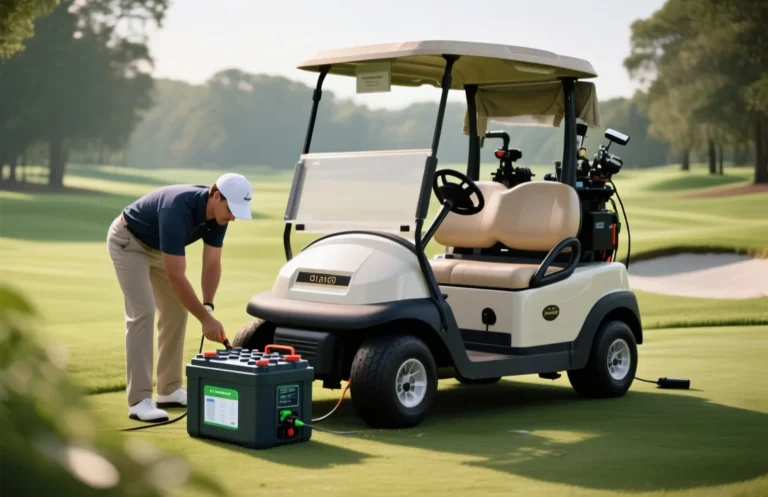
Most golf cart charging decisions come down to one spec, battery amp-hours. A common mistake is assuming every charger fills a battery at the same speed or using the wrong voltage. First check the battery plate and the charger label for voltage and amp rating before estimating time or leaving the charger unattended.
Golf cart battery charging time: estimate hours = battery amp-hours ÷ charger amps × 1.25 for inefficiency.
For example, a 200 Ah battery on a 20 A charger will need about 12.5 hours for a full charge; a 100 Ah battery on that charger needs about 6.25 hours.
Typical Charge Times
Expect typical full-charge times for common golf-cart battery systems to fall roughly into these ranges: flooded lead-acid about six to fourteen hours, AGM and other sealed lead-acid types about four to ten hours, and lithium (LiFePO4) packs often two to six hours, assuming a correctly matched charger. These ranges depend heavily on battery capacity, the charger current, state of charge at start, and the battery’s age and temperature.
| Chemistry | Typical full charge time (range) | Overnight top-up (hours) | Notes (what changes the time) |
|---|---|---|---|
| Flooded lead-acid | 6 to 14 hours | 6 to 10 hours (slow/C/10) | Charging speed limited by charger current and careful finishing stages, accepts lower charge currents to preserve life. |
| AGM / sealed lead-acid | 4 to 10 hours | 5 to 9 hours | Can handle slightly higher charge currents than flooded, but overcharging shortens life; temperature matters. |
| Lithium (LiFePO4) | 2 to 6 hours | 2 to 4 hours (top-up) | Charges faster but requires a charger or BMS set for lithium charge profile and correct cutoff voltages. |
Charge time varies for two main technical reasons: battery capacity in ampere-hours, and charger current in amperes. A larger Ah pack takes longer; a higher-current charger reduces time but increases heat and stress on older lead-acid batteries.
Other variables that change timing are the battery’s starting state of charge, temperature (cold slows chemical reaction), how many cycles the battery has been through, and whether the charger uses multi-stage algorithms. Chargers that taper current during absorption or absorption phases add hours but protect capacity.
For overnight charging expectations, most owners run a slow or factory-supplied charger overnight to bring the pack to full without stressing it. For flooded or AGM batteries, that usually means a long, low-current session of several hours. For LiFePO4, an overnight charge often finishes quickly and then the BMS holds the pack at float or standby.
Calculating Charge Time
Estimate charging time by dividing the battery’s usable amp-hours by the charger’s amp output, then correct for charging losses. In short, Hours ≈ Usable Ah ÷ (Charger amps × Charging efficiency).
For example, a 200 Ah golf cart battery charged from empty with a 25 A charger and 85 percent efficiency needs roughly 200 ÷ (25 × 0.85) = 9.4 hours to reach full. If that same battery is at 50 percent and you only need 100 Ah, charging time drops to about 4.7 hours using the same charger and efficiency.
For instance, a 225 Ah battery on a 15 A charger at 85 percent efficiency requires about 225 ÷ (15 × 0.85) = 17.6 hours from empty. Changing charger amperage or the efficiency assumption scales time predictably, so doubling charger amps roughly halves charge time, but higher currents can affect battery life.
Charger Types and Ratings
How long a golf cart battery takes to reach full charge is driven mostly by charger output current and the charger’s charge profile, not by brand names. A charger with a high bulk/absorb current will reduce the initial fill time, while absorption and float stages add hours to safely top off the battery and prevent damage.
Bulk, absorb, and float are the three stages you will see on multistage chargers. Bulk is the high-current phase that replaces the largest portion of capacity quickly, absorption reduces current while holding voltage to finish the charge, and float supplies a small holding current to keep a lead-acid battery topped off without overcharging.
Smart chargers manage those stages automatically and change current as the battery approaches full, which lengthens the final portion of the cycle but preserves battery life. Simple or single-stage chargers deliver a fixed current or voltage and can finish faster to a nominal voltage, but they can overcharge lead-acid cells or fail to fully balance a pack, which shortens life.
| Charger Type | Behavior | Effect on Charge Time |
|---|---|---|
| Simple single-stage | Fixed current/voltage, no absorb/float | May reach voltage quickly, risks overcharge, can underfinish top-off |
| Smart multistage | Bulk, absorb, float, automatic taper | Faster initial fill, longer safe finish, better battery life |
| High-amp fast | Higher bulk current, often reduced absorb time | Shorter bulk time, higher heat and maintenance needs for lead-acid |
| Multi-bank | Charges batteries individually within a pack | Prevents imbalance, may lengthen overall pack charge but improves longevity |
Rule: Match charger voltage and chemistry exactly; if the battery is flooded lead-acid expect longer absorption and float phases, if lithium, expect a CCCV profile with little or no float.
For example, using a smart multistage charger designed for your battery chemistry will often take longer to report “100%” than a crude high-amp charger, but it will avoid water loss, heat, and premature capacity loss. Always verify the charger specs against your battery manual before deciding if faster charging is worth the trade-off in maintenance or life reduction.
Charging Procedure and Best Practices
How long to charge a golf cart battery depends on the battery pack amp‑hour rating, the charger’s output current, and how depleted the pack is; calculate charging hours as (Ah × fraction to replace) / charger amps, then add roughly 10 to 20 percent for losses and taper. Slow charging at about one tenth of the battery Ah (C/10) is common for routine charging and typically finishes overnight from a moderate discharge, while higher-amp chargers reduce elapsed time but raise heat and stress the battery if used regularly.
For example, a 100 Ah pack that is 50 percent discharged needs 100 Ah × 0.5 = 50 Ah of charge. On a 10 A charger that is 50 / 10 = 5 hours, add about 10 to 20 percent for losses and taper, so plan roughly six hours from that starting point.
Do not rely on time alone. Always confirm state of charge with voltage, specific gravity where applicable, or the charger’s indication, and follow the battery manufacturer’s recommended charge currents and schedules to balance speed and long term life.
Charging Safety and Risks
Charging time for a golf cart battery varies with battery capacity, chemistry, state of charge and charger current, but the safety rule is simple: stop or inspect charging immediately if the battery becomes unusually hot, emits gas, swells, leaks, or shows charging that goes far longer than the manufacturer’s stated time. Continuing to charge through those signs can cause acid release, cell damage, thermal runaway on lithium packs, or fires on any chemistry.
Heat is the most common early warning. A warm battery is normal during charging, but if the case is too hot to touch, the charger should be disconnected and the battery allowed to cool; persistent heat often means the charger is set too high, the battery has internal damage, or cells are sulfated and resisting charge.
Gassing requires ventilation and attention. Flooded lead acid cells will release hydrogen and oxygen while accepting charge, so charge in a ventilated area and never enclose the battery in a confined space; sealed batteries can still vent under stress and lose electrolyte, which reduces capacity permanently.
Swelling and leaks are emergency signs that need immediate action. A bulging case, cracked top, bubbling sound, or visible fluid means the battery is compromised; do not reconnect or continue charging and avoid skin contact with any spilled electrolyte.
Always follow the battery maker’s charging time and temperature limits, replace damaged batteries immediately, and prefer slower, proper-current charging over forcing a rapid top-up when safety signs appear. If you are uncertain what the manufacturer recommends, stop charging and consult the manual or a qualified technician before continuing.
Maintenance and Storage
Charge time is set by the battery capacity divided by the charger current, adjusted for charging inefficiency. Use hours ≈ (Battery Ah × fraction of charge needed) / Charger amps × 1.2 as a quick rule of thumb to estimate how long a golf cart battery will take to reach the desired state of charge.
Charging inefficiency comes from heat, gassing, and tapering current as the battery approaches full, so a straight Ah/amp calculation underestimates real time. For batteries that are deeply discharged or sulfated the effective time can be noticeably longer because the charger will spend more time at lower currents near the end of the cycle.
For example, a 200 Ah battery going from 50 percent to 100 percent on a 20 A charger takes about (200 × 0.5)/20 × 1.2 ≈ 6 hours by the rule above, plus any extra time an equalization cycle requires.
Troubleshooting and Replacement Triggers
Estimate charge time by dividing the battery amp hour rating by the charger’s amp output, then multiply by about 1.1 to 1.3 to allow for inefficiency and end-of-charge tapering. If actual charging time is substantially longer than that calculation, something in the battery, wiring, or charger is reducing current or preventing full acceptance.
Quick Summary
Charging time depends on battery capacity and charger current; divide amp-hours by charger amps and allow extra float time.
Frequently Asked Questions
How long does it take to charge a golf cart battery?
You can estimate charge time with the formula hours = (battery amp-hours / charger amps) × 1.2 for inefficiency; for example, a 225 Ah bank on a 25 A charger charges in about 10.8 hours.
How long to charge a golf cart battery with a 48V 25A charger?
You can expect a full charge in roughly 9 to 12 hours for common 48V golf cart banks using a 25 A charger, for example a 225 Ah pack calculates to about 11 hours.
How long should I charge a golf cart battery before stopping if it feels hot?
You can stop charging and inspect if the battery surface exceeds about 125°F (52°C) or is too hot to touch, and always check the manufacturer temperature limit before continuing.
How long should you charge a new golf cart battery before first use?
You can fully charge a new lead-acid golf cart battery until the charger goes to float and the current falls to about C/100, for a 225 Ah bank that is under 2.25 A, then it is ready for service.
How long to charge a golf cart battery, and what common buying mistakes affect that time?
You can avoid long or damaging charge cycles by using a charger matched to the bank voltage and sized around C/10 so charging takes about 8 to 12 hours, for example a 225 Ah bank on a 25 A charger is about 11 hours; do not use a car battery charger or mismatched voltage charger.