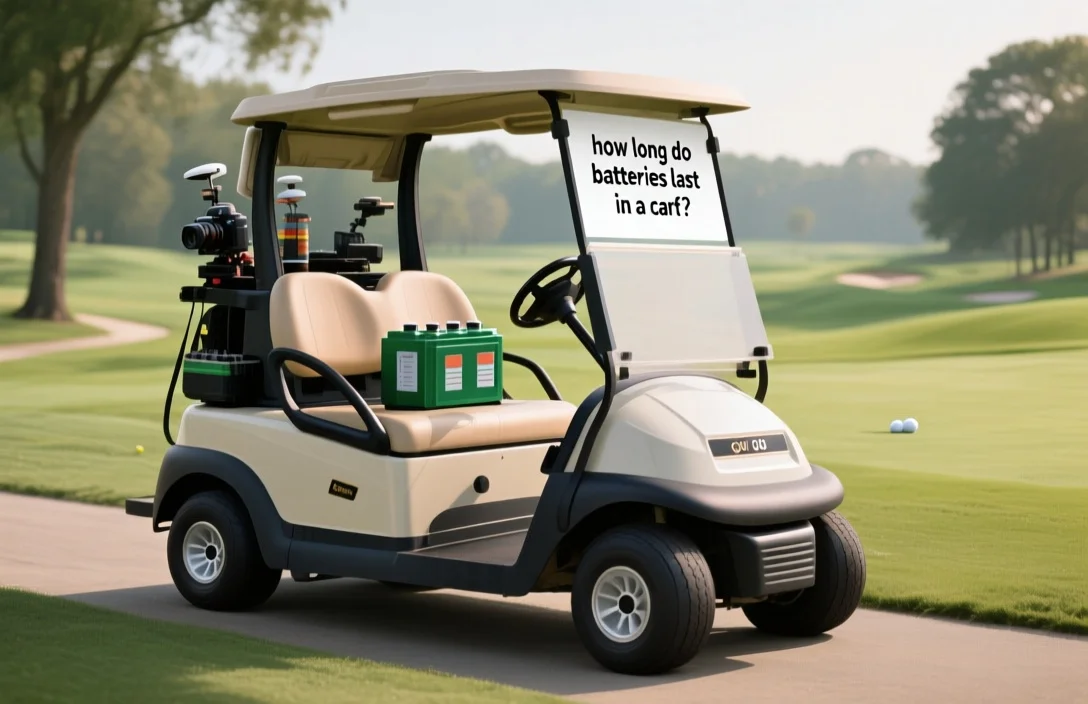
How long do batteries last in a golf cart?
Expect a golf cart battery pack to last roughly 3 to 10 years, depending on chemistry and how you charge and care for it. The spec that matters most is cycle life, listed as cycles or an expected years figure. A common mistake is judging lifespan by amp-hour rating; first check the battery chemistry and cycle rating on the case.
Golf cart batteries typically last 3 to 10 years: flooded lead-acid about 3-5 years, AGM 4-6 years, lithium 8-10+ years. Actual life depends on cycle count, charger type, temperature, and maintenance, so check the battery chemistry, cycle rating, and warranty for exact expectations.
Golf cart battery lifespans
Most traditional flooded lead-acid golf cart battery packs last roughly four to six years under regular use and basic maintenance, while lithium iron phosphate packs commonly last longer, often into the high single digits to mid-teens of years depending on cycle rating and thermal conditions. Published lifespans vary widely because manufacturers test under different depths of discharge, temperatures, and charge protocols, so the number on the spec sheet is a best-case laboratory figure for a narrow set of conditions.
Real-world life depends on how the cart is used, how deeply batteries are discharged each outing, whether cells are kept at safe temperatures, and whether the charger and maintenance routine match the battery type. Warranties and marketing numbers can be helpful, but they do not replace checking cycle rating, recommended depth of discharge, and required maintenance steps for the specific battery chemistry.
Common chemistries used in golf carts include flooded lead-acid, AGM or VRLA variants, and increasing numbers of LiFePO4 packs. Flooded batteries need periodic watering and tolerate abuse reasonably well for their cost, AGM is lower maintenance but more sensitive to overcharge, and LiFePO4 gives higher usable cycles and faster recharge but costs more upfront and needs a proper battery management system.
Cycle life refers to how many full charge and discharge cycles a battery can take before its capacity falls to a specified level, typically 70 to 80 percent of original capacity. Calendar life is the elapsed time the battery will remain usable even if not cycled, and it is driven mainly by chemistry, state of charge during storage, and temperature; check specs for both the cycle rating and the conditions used to derive it.
Capacity and runtime
A golf cart’s runtime comes from usable energy in the battery pack, which is amp‑hours times pack voltage, reduced by the depth of discharge, then divided by the motor’s average watt draw. Put simply, runtime hours = (Ah × V × DoD) ÷ load in watts.
Amp‑hours, written Ah on the battery label, are a measure of charge capacity at a given discharge rate. Higher Ah means more stored charge, but Ah alone does not tell you total energy unless you include voltage.
Voltage is the pack voltage, the sum of the series-connected battery voltages, usually 36 V or 48 V on common carts. Voltage sets the system potential and, together with Ah, gives watt‑hours, which are the practical energy units for runtime math.
Watt‑hours, Wh, equal Ah × V and are the cleanest way to compare packs and estimate runtime against motor load. Depth of discharge, DoD, is the fraction of total capacity you will actually use each cycle; limiting DoD increases cycle life but reduces per‑charge runtime.
Warning: using the full rated capacity every cycle, mixing different ages or chemistries, or running packs hot shortens life and can be unsafe. Check for swollen batteries, overheating, and damaged cables before trusting a calculated runtime.
For example, using a hypothetical 48 V pack rated 225 Ah, total energy is 48 × 225 = 10,800 Wh. With a 50% DoD usable energy is 5,400 Wh; a steady 1,000 W draw gives about 5.4 hours before losses, which you would reduce further by expected inefficiencies.
Charger compatibility
Using a charger that matches your golf cart battery chemistry, pack voltage, and recommended charge current is one of the biggest factors that controls how long the batteries last; the wrong profile or voltage will accelerate capacity loss and can cause early failure. Correct bulk, absorb, and float behavior for lead acid, or the correct CC/CV behavior and BMS interaction for lithium, preserves cycle life and reduces heat and corrosion.
Lead acid systems need a three-stage approach: high-current bulk to restore most capacity, a controlled absorb stage to finish charging without gassing excessively, and a float stage to keep the pack topped without overcharging. Lithium packs typically use a constant-current, then constant-voltage profile, often do not require a prolonged float, and rely on the battery management system, BMS, to protect cells.
For example, when replacing a 48 volt lead acid bank with a 48 volt lithium pack, you must either fit a lithium-capable charger and ensure BMS communication, or install a charger specified by the lithium battery maker; leaving a lead acid float regime in place will reduce lithium cycle life and can trigger BMS cutoffs. Always check the battery and charger manuals and confirm settings before the first charge.
Proper charger compatibility is a practical, relatively low-cost way to protect your golf cart battery investment and keep batteries close to their expected life; when in doubt, confirm specs with the battery maker or use a charger explicitly labeled for that battery type. Replacing a charger or adjusting its profile is often the correct action before replacing batteries prematurely.
Maintenance to extend life
Regular, chemistry-specific maintenance is the single most effective way to keep golf cart batteries reaching their expected service life; for flooded lead acid that means watering, cleaning, and occasional equalization, while for lithium it means keeping the BMS healthy and the pack balanced. Seasonal storage and temperature control reduce irreversible capacity loss for both chemistries.
For flooded lead acid, check electrolyte levels, clean terminals, and equalize only when cells diverge or per the manufacturer schedule. Use distilled water, add it after charging so plates are not exposed, and never overfill above the plate marker. Clean corrosion with a baking soda solution, tighten connections, and coat terminals with a light film of dielectric grease to slow corrosion.
Lithium packs do not require watering or equalization, but they do need BMS and balance attention. Check BMS fault logs, verify cell voltages or state-of-charge balance through the cart display or service tool, and install firmware updates if the OEM provides them. Never open or bypass the BMS, and avoid mixing new and old modules in the same pack unless the manufacturer permits it.
| Task | Flooded Lead Acid | Lithium | Why it extends life |
|---|---|---|---|
| Watering | Monthly during use, after charging, distilled water only | Not applicable | Prevents plate exposure and sulfation for flooded cells |
| Equalization | Occasional, per gravity spread or manual | Not applicable | Restores cell balance and reduces capacity drift in flooded banks |
| BMS checks / balancing | Simple voltage checks, terminal care | Diagnostics and balancing when imbalance appears | Keeps cells within safe limits and prevents destructive over/under voltage events |
| Storage / temperature | Cool, charged, protected from freeze | Cool, partial charge, avoid full SOC extremes | Reduces calendar aging and capacity loss |
Safety: Never add battery acid or use tap water in flooded cells, never bypass the BMS on lithium packs, and avoid charging or storing batteries where they can overheat or freeze. If a battery is swollen, leaking, or emits a strong odor, stop use and get professional service.
Practical next steps: set a calendar reminder for monthly inspections during the season, keep a simple log of water additions and hydrometer readings for flooded banks, and record BMS fault codes for lithium packs. If maintenance does not stop rapid capacity loss, plan for a professional load test or replacement, since routine care can only delay, not permanently fix, internal cell degradation.
Troubleshooting common issues
A sudden or steady drop in golf cart range usually means the battery string has lost usable amp-hour capacity because of age, sulfation, a weak cell, or charging faults. You can diagnose most causes with a few measurements: resting and under-load voltages, a conductance or impedance test, electrolyte checks on flooded cells, and a capacity run-down or lab test when needed.
For example, if one battery measures lower at rest and the cart cuts range sharply under throttle, that single battery is often the root cause and will pull down the whole pack. Replacing a single weak battery can restore much of the lost runtime, but proper testing should confirm the failure mode first.
| Test | If result | Likely cause | Next step |
|---|---|---|---|
| Resting voltage mismatch | One low vs others | Weak/failing cell | Conductance test or replace battery |
| Voltage sag under load | Large drop | High internal resistance | Load test and replace as necessary |
| Slow charge acceptance | Long charge, low specific gravity | Sulfation or plate damage | Try equalization, then lab test |
Safety note: If testing reveals swelling, cracked cases, persistent overheating, or electrolyte leakage, stop using the cart and call a qualified technician. Handling high-voltage battery strings and disposal of failed batteries require trained personnel and proper equipment.
Safety, heat, swelling
Heat and swelling are common failure modes that shorten golf cart battery life and can force early replacement. Swollen cases, persistent overheating, venting, or repeated BMS shutdowns are safety signals that you should stop using the pack and get professional service or recycling arranged.
High temperatures speed chemical breakdown inside cells, cutting cycle life and capacity well before the calendar life you might expect. Managing temperature and watching for signs of internal gas, acid leaks, or electronic faults is the single most effective way to keep a pack near its rated lifespan.
Buying and replacement checks
Typical golf cart battery life depends on chemistry and use: lead-acid deep-cycle packs commonly last around four to six years with proper maintenance, while lithium packs (for example LiFePO4) often last longer, frequently eight years or more depending on cycles and the BMS. Replace batteries when capacity loss, severe voltage sag under load, or repeated charger failures occur rather than replacing strictly by calendar age.
Quick Summary
Golf cart battery lifespan varies widely by type, use, and maintenance, so expect significant variation rather than a single fixed number.
Frequently Asked Questions
How long do batteries last in a golf cart for different battery types?
You can expect typical flooded lead-acid golf cart batteries to last about 4 to 6 years with regular watering and maintenance, while lithium packs commonly last around 6 to 10 years, though exact life depends on cycle count and usage.
How long do batteries last in a golf cart if it’s stored or operated in hot conditions?
Heat shortens battery life, and if a battery is regularly exposed to temperatures above about 30°C (86°F) you can see roughly a 20 to 50 percent reduction in usable life, so keep batteries shaded and ventilated.
How long do batteries last in a golf cart on a single charge, and how can I estimate runtime?
Runtime depends on battery capacity and motor load, use runtime hours = (battery volts × amp-hours) ÷ motor watts; for example a 48V 100Ah bank holds about 4.8 kWh and will run roughly 4.8 hours at a continuous 1 kW draw.
How long do batteries last in a golf cart before they become unsafe and need replacement?
Replace batteries immediately if you see swelling, leaking, or overheating, otherwise plan to replace when usable capacity drops to about 50 to 70 percent of new or when runtime and charging behavior degrade noticeably.
How long do batteries last in a golf cart if I make common buying or maintenance mistakes?
If you buy the wrong type, undersize the bank, use an improper charger, or frequently leave lead-acid batteries discharged, lifespan can fall to around 1 to 3 years, so you should match battery chemistry, capacity, and charger to the cart and follow maintenance schedules.