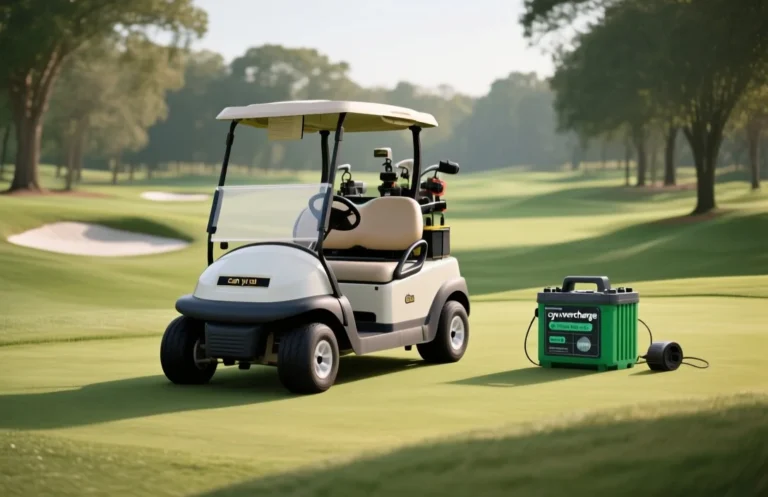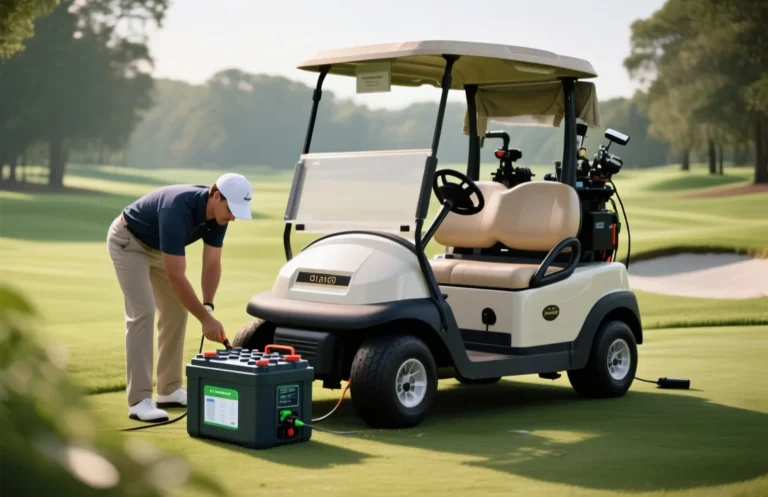

How long to charge golf cart batteries?
Charger current in amps is the single most important spec for how long your golf cart batteries will take to charge. A common mistake is reading only voltage and ignoring amp-hour capacity, which makes a small charger take many more hours. First check the battery bank label for bank voltage and Ah, then read the charger amp rating on its sticker.
How long to charge golf cart batteries? Typical lead-acid 36V banks take 6 to 8 hours, 48V lead-acid banks take 8 to 10 hours on standard chargers; LFP (lithium iron phosphate) banks usually charge in 2 to 5 hours. Calculate time with hours = (Ah × % SOC needed) ÷ charger amps ÷ 0.85.
Quick Answer & Calculation
Typical full-charge times: a 36 volt lead-acid golf cart bank usually finishes in about 6 to 8 hours with a standard charger, while a 48 volt lead-acid bank typically needs 8 to 10 hours. Lithium iron phosphate, or LFP, banks commonly finish in 2 to 5 hours with an appropriate charger and BMS, so lead-acid is generally overnight and LFP allows faster top-ups.
Use this copyable formula to estimate hours: hours = (Ah × ΔSOC) ÷ chargerA ÷ 0.85. The formula assumes Delta SOC (ΔSOC) is a decimal, for example going from 20 percent to 100 percent is 0.80.
| Bank Ah (typical) | Overnight charger (A) | Faster target (4 hour) (A) | Safe continuous max |
|---|---|---|---|
| 150 – 225 Ah | 15 – 30 A | 40 – 60 A | 0.25C for lead-acid, 0.5C+ for LFP if rated |
| 225 – 300 Ah | 25 – 40 A | 60 – 80 A | same % guidance, check battery label |
Worked Numerical Examples
Use hours = (Ah needed) ÷ (charger amps) and add a small efficiency and absorption allowance; lead-acid typically needs 15 to 30 percent extra time for absorption and losses, while LFP usually needs about 5 to 10 percent extra. Below are four worked examples with times to 80 percent and to 100 percent state of charge, and notes on absorption or BMS behavior.
For example, 36 V, 225 Ah flooded battery, 20 percent to 80 percent on a 25 A charger: required Ah = 225 × 0.60 = 135 Ah, time = 135 ÷ 25 = 5.4 hours to reach 80 percent. To go 20 percent more (80 to 100 percent) needs 45 Ah ÷ 25 = 1.8 hours nominal, but absorption taper adds about 25 percent, so absorption ≈ 2.25 hours and total ≈ 7.7 hours.
For example, same 36 V, 225 Ah flooded on a 12 A charger: 135 Ah ÷ 12 = 11.25 hours to 80 percent. The last 45 Ah ÷ 12 = 3.75 hours will taper; with a 25 percent absorption allowance that portion ≈ 4.7 hours, total ≈ 16.0 hours, so overnight charging is fine but full charge may stretch into the next day.
For example, 48 V, 150 Ah LFP from 50 percent to 80 percent on a 30 A charger: need 45 Ah ÷ 30 = 1.5 hours to 80 percent. To 100 percent need 75 Ah ÷ 30 = 2.5 hours nominal; add ~5 percent for charge inefficiency and CV taper, giving ≈ 2.6 hours total. Note, the BMS will often cut charge current quickly once cells reach full, so actual topping time is short compared with lead‑acid.
For example, 48 V lead‑acid bank 200 – 225 Ah from 30 percent to 100 percent on a 25 A charger: for 200 Ah, 70 percent = 140 Ah ÷ 25 = 5.6 hours raw; split into 4.0 hours to 80 percent plus 1.6 hours nominal for the final 20 percent, with absorption adding ~30 percent to that last portion (final ≈ 2.1 hours) for a total ≈ 6.1 hours. For 225 Ah, same math gives ≈ 4.5 hours to 80 percent and ≈ 2.3 hours absorption, total ≈ 6.8 hours; timed absorption or equalization cycles can add another hour or two if the charger runs them.
| System | Start SOC | Charger A | Time to 80% | Time to 100% | Notes |
|---|---|---|---|---|---|
| 36 V, 225 Ah flooded | 20% | 25 A | 5.4 h | ≈7.7 h | Absorption adds ~25% to last 20% |
| 36 V, 225 Ah flooded | 20% | 12 A | 11.25 h | ≈16.0 h | Much slower, longer absorption and watering needs |
| 48 V, 150 Ah LFP | 50% | 30 A | 1.5 h | ≈2.6 h | LFP has short CV taper, BMS may cut charge early |
| 48 V, 200 – 225 Ah lead‑acid | 30% | 25 A | 4.0 – 4.5 h | ≈6.1 – 6.8 h | Absorption stage can add 20 – 30% to final portion |
Safety note: never exceed the battery maker’s recommended maximum charge current and inspect for overheating, swelling, damaged cables, or bulging cells before charging. If charging takes much longer than these worked examples predict, test batteries for capacity or specific gravity and verify the charger is operating correctly.
Common Banks and Chargers
Most 36V banks (6×6V or 3×12V) typically reach about 80 percent in 2 to 6 hours and 100 percent in 6 to 10 hours on a standard charger, while 48V banks (8×6V or 4×12V) typically reach 80 percent in 3 to 8 hours and 100 percent in 8 to 12 hours, depending on battery Ah and charger amperage. The charger current relative to bank capacity drives the time, with lead acid chargers sized at roughly 10 to 20 percent of Ah and lithium (LFP) limited by manufacturer C‑rate and BMS settings.
| Bank (typical) | Common Ah | Recommended Charger Amps | Approx time to 80% | Approx time to 100% |
|---|---|---|---|---|
| 36V (6×6V / 3×12V) | 170 Ah | 17 – 34 A (10 – 20% C) | 3 – 5 hours | 6 – 9 hours |
| 36V (6×6V / 3×12V) | 225 Ah | 22 – 45 A | 4 – 6 hours | 7 – 10 hours |
| 48V (8×6V / 4×12V) | 150 Ah | 15 – 30 A | 3 – 5 hours | 6 – 9 hours |
| 48V (8×6V / 4×12V) | 200 – 230 Ah | 20 – 46 A | 4 – 7 hours | 8 – 12 hours |
Simple charging formula: hours = (Ah × fraction of battery to replace) ÷ charger amps, then multiply by a correction factor (lead acid 1.15 – 1.25 to allow for absorption and losses, lithium 1.05 – 1.15 if BMS is efficient).
For example, a 48V 200 Ah lead acid bank charging from 20 percent to 100 percent on a 40 A charger is about (200 × 0.8) ÷ 40 = 4 hours, multiplied by ~1.2 for absorption yields about 4.8 hours. Use that pattern to calculate times for your exact Ah and charger rating.
Safety note: avoid mismatched voltage chargers, overheated or swollen batteries, and cheap unregulated chargers. Always confirm charger voltage, current rating, and chemistry setting before regular use.
Charging Stages and Voltages
A full charge time depends on chemistry, charger current, and how long the charger spends in absorption or CV tapering: lead-acid 36V/48V banks commonly need 6 to 12 hours on a standard charger, while LFP banks often finish in 2 to 6 hours because they accept charge faster and do not need a float stage. Use hours = (Ah × %SOC change) ÷ charger amps, then multiply by an efficiency factor (lead-acid 1.15 – 1.3, LFP 1.03 – 1.1) to account for absorption, heat, and losses.
Lead-acid charging has three practical stages. Bulk supplies the maximum charger current and brings the battery to about 70% to 85% of its charge, often the fastest portion. Absorption is constant-voltage, current tapers and this stage can take 30% to 60% of total clock time depending on depth of discharge and battery health. Float holds a lower voltage to maintain full charge, and is only used for lead-acid to prevent gassing and sulfation when left on charger.
For example, a 36V 225Ah flooded bank on a 25A charger from 20% to 100% needs 225×0.80 = 180Ah, 180÷25 = 7.2 hours raw; with a 1.25 lead-acid factor expect about 9 hours. For 20% to 80% that same bank needs 135Ah, 135÷25 = 5.4 hours raw, adjusted to about 6.5 hours.
In practice, a 48V 200Ah LFP pack on a 50A charger from 20% to 100% needs 160Ah, 160÷50 = 3.2 hours raw, and with ~1.05 efficiency expect roughly 3.4 hours because LFP accepts current quickly and cuts off at BMS limits.
| Chemistry / Unit | Absorption / Full | Recommended Float |
|---|---|---|
| Flooded 6V | 7.2 – 7.35V | 6.6 – 6.8V |
| Flooded 8V | 9.6 – 9.9V | 8.8 – 9.1V |
| Flooded/AGM 12V | 14.4 – 14.8V (AGM upper range) | 13.2 – 13.8V |
| Gel 12V | 14.1 – 14.3V | 13.6 – 13.8V |
| LFP per cell | 3.55 – 3.65V/cell (no float) | no float, BMS cutoff |
| LFP 6/8/12V units | 6V:7.1 – 7.3V, 8V:10.65 – 10.95V, 12V:14.2 – 14.6V | n/a |
Safety: never force a charger to higher voltage than the battery spec, and stop charging immediately if batteries overheat, swell, or emit strong odors.
Charger Selection and Use
Charging time is calculated as hours = (battery amp‑hours × percent of state of charge to replace) ÷ charger amps, then multiplied by an efficiency factor (lead‑acid 1.15 – 1.25, lithium 1.05 – 1.15) to allow for absorption and losses. Typical full charge times from low state are about 6 – 9 hours for 36 volt lead‑acid banks, 8 – 12 hours for 48 volt lead‑acid, and 2 – 5 hours for most lithium packs on appropriately sized chargers.
For example, a 36V, 225 Ah flooded bank taken from 20% to 100% needs 225 × 0.80 = 180 Ah. On a 25 A charger that is 180 ÷ 25 = 7.2 hours, multiplied by a 1.2 correction = about 8.6 hours to finish absorption. To reach 80% from 20% you need 135 Ah, or 135 ÷ 25 = 5.4 × 1.2 = about 6.5 hours.
| System | Common Ah | Typical charger amps | Typical full charge time (lead‑acid) | Typical full charge time (lithium) | Safe max charge current guideline |
|---|---|---|---|---|---|
| 36 V bank | 150 – 225 Ah | 20 – 40 A | 6 – 9 hours | 2 – 4 hours | 0.1 – 0.2 C (lead), 0.3 – 1.0 C (lithium, per manufacturer) |
| 48 V bank | 150 – 225 Ah | 25 – 50 A | 8 – 12 hours | 3 – 5 hours | 0.1 – 0.2 C (lead), 0.3 – 1.0 C (lithium, per manufacturer) |
| Single 12 V cell (reference) | 100 – 225 Ah | 10 – 45 A | 10 – 20 hours (by small chargers) | 2 – 6 hours | 0.1 – 0.2 C (lead), follow BMS for lithium |
Smart multi‑stage chargers are the preferred choice: they do bulk, absorption, and float (or CC/CV for lithium) and switch automatically, which shortens overall time while protecting battery life. Basic single‑stage or timed chargers are cheaper and fine for predictable, repeatable use where depth of discharge and temperature are constant, but they can overcharge or undercharge when conditions vary.
Manufacturer checklist before buying or using a charger: confirm recommended absorption and float voltages, allowed max charge current (C‑rate), required temperature compensation, presence of an appropriate profile for flooded/AGM/gel/LFP, and whether the charger will interface safely with the pack BMS.
Safety note: if charging takes significantly longer than calculated, test battery health (terminal voltage under load, specific gravity for flooded cells, or BMS fault logs for lithium) before increasing charge current. Incorrect charger choice, missing temperature compensation, or undersized wiring are common causes of slow or damaging charges.
Safety, Maintenance & Troubleshooting
A full charge time is typically 6 – 8 hours for a 36 volt lead-acid bank and 8 – 10 hours for a 48 volt lead-acid bank, while lithium (LFP) packs commonly finish in 2 – 5 hours depending on charger amperage. Use this simple formula to estimate time: hours = (Ah × %SOC change) ÷ charger amps × 1.2, where 1.2 is a practical efficiency factor to cover absorption losses and heat.
Safety warnings must come first: flooded lead-acid batteries will gas hydrogen during absorption, so always charge in a well ventilated area, keep sparks and open flames away, and remove metal jewelry. Overcharging flooded batteries will boil off water and warp plates; overcharging sealed AGM or gel can permanently reduce capacity; lithium can overheat and swell if abused or charged in freezing temperatures.
Recommended charger sizing and safe maximums, for planning: use 0.1C to 0.2C for lead-acid (for example, a 225 Ah bank is normally charged at 22.5 A to 45 A). Lithium packs can accept higher rates if approved – typically 0.2C to 0.5C or higher per manufacturer guidance, but always verify the pack rating.
Quick tests to run: measure open-circuit voltage after 6 hours rest, perform a 10 second load test and record voltage sag, use a hydrometer on flooded cells for gravity, and check charger output current during bulk stage. If results deviate from expected by more than 10 to 20 percent, treat the bank as compromised and follow replacement or repair steps.
FAQ highlights: charge nightly for lead-acid to allow full absorption, charging to 80 percent reduces stress and extends life when frequent shallow cycles dominate, and always confirm charger output and battery maker specs before increasing charge current. When in doubt, prioritize ventilation, correct watering, and verifying voltages over squeezing faster charge times.
Quick Reference Cheat Sheet
Typical full-charge time for common golf cart systems is roughly 6 to 10 hours for 36V and 48V lead-acid banks, and 2 to 5 hours for lithium (LFP) packs when using appropriately sized chargers. Use the simple formula below to calculate the time for your specific bank, then apply the efficiency correction for chemistry and absorption time.
For example, a 36V 225 Ah flooded bank charged from 20% to 100% on a 25 A charger needs 225 × 0.8 = 180 Ah, base = 180 ÷ 25 = 7.2 hours, with 1.2 efficiency = about 8.6 hours. For a 48V 200 Ah LFP bank on a 50 A charger, 200 ÷ 50 = 4 hours, with 1.05 = about 4.2 hours to full.
| System | Bank Ah | Charger (typical) | Full charge 0 – 100 |
|---|---|---|---|
| 36V lead‑acid | 225 Ah | 25 A | 8 – 10 hours |
| 48V lead‑acid | 210 Ah | 30 A | 8 – 12 hours |
| 36V LFP | 100 Ah | 50 A | 2 – 4 hours |
| 48V LFP | 200 Ah | 50 A | 3 – 5 hours |
Safety: Never exceed the charger current rating the battery maker specifies, and avoid charging if batteries are swollen, very hot, or leaking. For flooded cells check and top water after charging only when the bank is fully charged and cooled.
Use the formula and table to size chargers and plan overnight charging, and always verify voltages or BMS cutoffs at the end of charge rather than relying only on elapsed time. Replace weak banks rather than forcing faster charging, because longer charge time can signal failing cells.
Quick Summary
Charging a golf cart battery usually takes about 6 to 10 hours, varying with voltage, chemistry, charger power, and state of charge.
Frequently Asked Questions
How long to charge 36V or 48V golf cart batteries?
You can expect a standard lead-acid 36V pack to take about 6-8 hours from near empty, while a 48V lead-acid pack usually takes about 8-10 hours with a stock charger.
How long should I charge golf cart batteries in hot weather?
If batteries are hot after use, let them cool for about 2 hours before charging, because high temperatures can increase charging time and stress the cells; always check your owner manual for the manufacturer temperature guidance.
How long do I need to charge golf cart batteries to get a full day’s runtime?
Charge until the charger reaches float or indicates full to get rated range, which is typically 8-10 hours for lead-acid and 2-5 hours for lithium, depending on how depleted the pack is and the charger wattage.
How long can I safely charge golf cart batteries overnight?
You can usually leave batteries on an automatic charger overnight because most modern chargers switch to a float stage, so a typical overnight session is about 8-10 hours for lead-acid; do not leave non-automatic chargers unattended and maintain ventilation.
How long should I try charging golf cart batteries before deciding they need replacement or that I bought the wrong type?
Run a full charge cycle for the battery type, typically 8-10 hours for lead-acid or 2-5 hours for lithium; if the pack does not reach expected voltage, loses charge very quickly, or individual cells test bad after a full charge, you likely need replacement or a compatibility check.