Can you overcharge golf cart batteries?
Yes, you can overcharge golf cart batteries. Most golf carts use lead-acid deep-cycle cells, and holding them above the correct float voltage for hours causes gassing, water loss, and plate damage. The single spec that matters most is float voltage, and the first thing to check is the battery pack label and the charger voltage or mode setting.
Can you overcharge golf cart batteries? Yes, lead-acid packs can be overcharged if held above the manufacturer float voltage; a typical 12V float is about 13.2-13.8V, and sustained charging at higher voltages for hours leads to gassing, water loss, and shortened battery life.
Can you overcharge golf cart batteries?
Yes, golf cart batteries can be overcharged, and that risk depends on chemistry and the charging system. Lead‑acid packs (flooded, AGM, gel) are especially vulnerable to prolonged excess voltage, while lithium packs usually rely on a battery management system that cuts charging, but a bad charger or wiring can still cause problems.
For example, a replacement charger bought online that is labeled for “48V lithium” but used on a lead‑acid pack, or a cheap charger that never shifts to a float state, will raise voltage beyond the battery maker’s recommended limits and keep supplying current long after the pack is full.
Bottom line, overcharging is a real and preventable risk: match chargers to chemistry, keep the cart’s charging controls maintained, and stop charging if anything looks or feels wrong. When unsure, get the charger and pack checked rather than guessing.
Damage from overcharging
Yes, you can overcharge golf cart batteries, and the damage is often permanent: flooded lead acid cells lose water and expose plates, sealed lead acid types vent or bulge, and lithium packs can overheat or trip protection that masks internal damage. Repeated overvoltage shortens cycle life, reduces usable capacity, and raises safety risks during charging and use.
Overcharging harms batteries by driving unwanted chemical reactions and creating mechanical stress inside the cells. The following list explains the main failure modes so you can recognize them and act before permanent loss accumulates.
For example, a flooded 6V golf cart battery that is left on a high-voltage charger will show falling water level, frequent need to top off, and progressive shortening of run time; replacing plates or the battery becomes the only fix. If you see these signs, assume capacity is lost and plan replacement rather than extended repair.
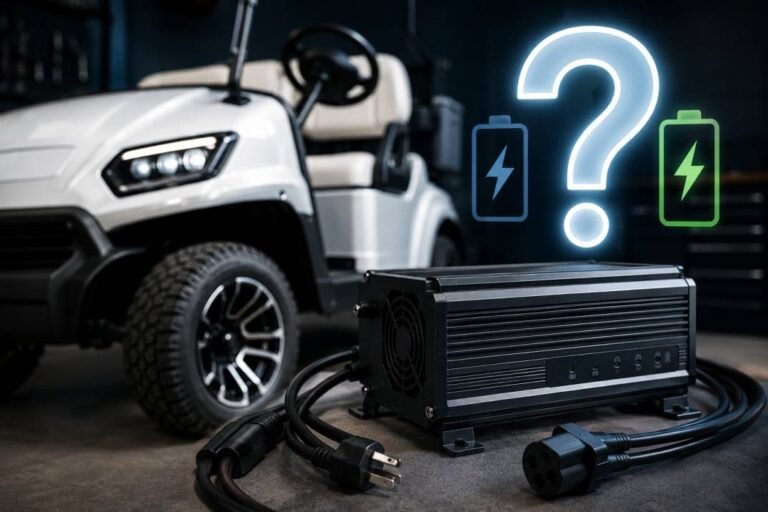
Choosing the right charger
Yes, golf cart batteries can be overcharged if the charger applies too high a voltage, holds a finishing voltage too long, or lacks proper float and temperature compensation. A correctly matched, smart multi-stage charger that shifts to a lower float voltage and compensates for temperature will prevent overcharge in normal use.
Start by matching the charger to the battery pack nominal voltage and connector type, then confirm the charger’s maximum charge current is appropriate for the battery amp‑hour capacity. Buying the wrong voltage or a charger that cannot regulate current and voltage reliably is the single biggest cause of overcharging events.
| Charger type | Behavior near full | Overcharge risk | When to choose |
|---|---|---|---|
| Basic single‑stage | Holds fixed voltage until disconnected | High | Only for short, supervised charging |
| Automatic fixed‑voltage | May reduce current, not true float | Moderate | Budget option, monitor battery |
| Smart multi‑stage (recommended) | Bulk → absorption → float, temp comp | Low | Daily charging, long battery life |
| On‑board cart charger | Varies by manufacturer | Varies, check specs | Convenient but verify auto‑float |
Safety: If a battery gets hot, swells, vents, or emits a strong sulfur smell while charging, stop charging and disconnect. Continued charging under those conditions increases the chance of permanent damage or hazardous failure.
Charge rate and runtime
Yes, you can overcharge golf cart batteries if charging current continues after the battery reaches full state of charge without proper voltage regulation or float control; that extra energy forces gassing, heats the battery, and accelerates water loss or plate corrosion. Higher charge currents shorten charge time but raise the risk of overheat and incomplete absorption unless the charger reduces voltage or current at the right point.
Amp‑hours, abbreviated Ah, tell you how much current a battery supplies for one hour, so a 100 Ah battery can theoretically deliver 10 amps for 10 hours. C‑rate expresses charge or discharge current relative to capacity: 0.1C on a 100 Ah battery is 10 amps, 0.5C is 50 amps, and so on; higher C means faster charging but more heat and stronger need for accurate control.
For example, if your golf cart has a 150 Ah battery and the cart draws 15 amps under typical use, simple math gives about 10 hours of run time from full charge, before accounting for inverter losses, wiring losses, and recommended depth of discharge. Real world runtime will be lower because lead‑acid batteries should not be fully drained repeatedly, and charging is not 100 percent efficient so the last portion of charge takes disproportionately longer.
Higher charge currents need smarter control because the battery does not accept charge at a constant rate to full. Fast charging drives temperature up and causes stronger gassing during the absorption phase; without staged CC/CV control, temperature compensation, or a proper float stage, continuous high current will push the battery past its safe chemical limits and produce permanent damage.
| Spec | Why it matters |
|---|---|
| Nominal voltage | Determines charger voltage and whether cells/strings match the charger output. |
| Ah rating and test period | Used to estimate runtime and calculate C‑rate for charging or discharging. |
| Maximum recommended charge current | Sets safe charge limits to avoid overheating and excessive gassing. |
| Recommended charge profile (float/absorption voltages) | Needed so the charger transitions correctly and avoids continuous overvoltage. |
| Operating and charge temperature range | Temperature affects acceptance of charge and can require compensation to prevent overcharge. |
| Cycle life and warranty conditions | Shows tradeoffs: faster charging often reduces cycle life and may void warranty if limits are exceeded. |
Preventing overcharge
Yes, you can overcharge golf cart batteries, which causes gassing, water loss, heat, and reduced capacity, but proper charger selection and maintenance prevent it. Use a charger matched to the battery chemistry and voltage, enable float/maintenance mode for stored batteries, keep flooded cells watered, and run equalization only when the manufacturer specifies.
Preventing overcharge is mostly about matching equipment to the battery, using chargers with proper float behavior, and staying on a regular maintenance schedule. Follow the maker’s equalization rules, and treat ventilation and water topping as safety-critical tasks rather than optional chores.
Diagnosing overcharged batteries
Yes, golf cart batteries can be overcharged, and overcharge shows quickly as heat, excessive gassing, lost electrolyte, and falling usable capacity. Left unchecked, overcharge can warp plates, corrode connections, and produce permanent capacity loss or safety failures that require replacement.
For example, if one battery measures normal voltage but a single cell shows low specific gravity and that battery runs down fast, that battery is internally damaged and replacement is the safer choice.
Quick Summary
Yes, golf cart batteries can be overcharged, so use the correct charger and settings to avoid damage and safety hazards.
Frequently Asked Questions
Can you overcharge golf cart batteries with the wrong charger?
You can overcharge a golf cart battery if the charger voltage does not match the pack, for example using a 48V charger on a 36V pack will overvolt the batteries, so always match charger output to pack voltage and chemistry and check the charger label.
Can you overcharge golf cart batteries by leaving a charger connected overnight?
You can cause overcharge if the charger does not have an automatic float or maintenance mode, so stop charging when batteries reach the manufacturer’s full-charge voltage; for many lead-acid setups a common bulk/equalize limit is about 14.4 to 14.8 volts for a 12V string, then switch to float or disconnect.
Can you overcharge golf cart batteries to get longer runtime?
You can not gain usable runtime by overcharging, overcharge damages plates and reduces capacity, so follow the recommended charge procedure; a useful specification to check is float voltage, commonly around 2.25 to 2.35 volts per cell for lead-acid batteries.
Can you overcharge golf cart batteries and is it dangerous?
You can create hazardous conditions when batteries are overcharged because gassing and heat increase, so always charge in a ventilated area and stop if the battery is hot or swollen; note that hydrogen becomes explosive at about 4% concentration in air.
Can you overcharge golf cart batteries, how will you know when to replace them and avoid buying the wrong charger?
You can recognize overcharge damage by persistent low capacity, swelling, or high self-discharge, and if a battery holds less than 50% of rated capacity on a load test you should replace it and avoid cheap chargers that lack automatic voltage control and float modes.
Frequently Asked Questions
Can you overcharge golf cart batteries with the wrong charger?
You can overcharge a golf cart battery if the charger voltage does not match the pack, for example using a 48V charger on a 36V pack will overvolt the batteries, so always match charger output to pack voltage and chemistry and check the charger label.
Can you overcharge golf cart batteries by leaving a charger connected overnight?
You can cause overcharge if the charger does not have an automatic float or maintenance mode, so stop charging when batteries reach the manufacturer’s full-charge voltage; for many lead-acid setups a common bulk/equalize limit is about 14.4 to 14.8 volts for a 12V string, then switch to float or disconnect.
Can you overcharge golf cart batteries to get longer runtime?
You can not gain usable runtime by overcharging, overcharge damages plates and reduces capacity, so follow the recommended charge procedure; a useful specification to check is float voltage, commonly around 2.25 to 2.35 volts per cell for lead-acid batteries.
Can you overcharge golf cart batteries and is it dangerous?
You can create hazardous conditions when batteries are overcharged because gassing and heat increase, so always charge in a ventilated area and stop if the battery is hot or swollen; note that hydrogen becomes explosive at about 4% concentration in air.
Can you overcharge golf cart batteries, how will you know when to replace them and avoid buying the wrong charger?
You can recognize overcharge damage by persistent low capacity, swelling, or high self-discharge, and if a battery holds less than 50% of rated capacity on a load test you should replace it and avoid cheap chargers that lack automatic voltage control and float modes.
Frequently Asked Questions
Can you overcharge golf cart batteries with the wrong charger?
You can overcharge a golf cart battery if the charger voltage does not match the pack, for example using a 48V charger on a 36V pack will overvolt the batteries, so always match charger output to pack voltage and chemistry and check the charger label.
Can you overcharge golf cart batteries by leaving a charger connected overnight?
You can cause overcharge if the charger does not have an automatic float or maintenance mode, so stop charging when batteries reach the manufacturer’s full-charge voltage; for many lead-acid setups a common bulk/equalize limit is about 14.4 to 14.8 volts for a 12V string, then switch to float or disconnect.
Can you overcharge golf cart batteries to get longer runtime?
You can not gain usable runtime by overcharging, overcharge damages plates and reduces capacity, so follow the recommended charge procedure; a useful specification to check is float voltage, commonly around 2.25 to 2.35 volts per cell for lead-acid batteries.
Can you overcharge golf cart batteries and is it dangerous?
You can create hazardous conditions when batteries are overcharged because gassing and heat increase, so always charge in a ventilated area and stop if the battery is hot or swollen; note that hydrogen becomes explosive at about 4% concentration in air.
Can you overcharge golf cart batteries, how will you know when to replace them and avoid buying the wrong charger?
You can recognize overcharge damage by persistent low capacity, swelling, or high self-discharge, and if a battery holds less than 50% of rated capacity on a load test you should replace it and avoid cheap chargers that lack automatic voltage control and float modes.
Frequently Asked Questions
Can you overcharge golf cart batteries with the wrong charger?
You can overcharge a golf cart battery if the charger voltage does not match the pack, for example using a 48V charger on a 36V pack will overvolt the batteries, so always match charger output to pack voltage and chemistry and check the charger label.
Can you overcharge golf cart batteries by leaving a charger connected overnight?
You can cause overcharge if the charger does not have an automatic float or maintenance mode, so stop charging when batteries reach the manufacturer’s full-charge voltage; for many lead-acid setups a common bulk/equalize limit is about 14.4 to 14.8 volts for a 12V string, then switch to float or disconnect.
Can you overcharge golf cart batteries to get longer runtime?
You can not gain usable runtime by overcharging, overcharge damages plates and reduces capacity, so follow the recommended charge procedure; a useful specification to check is float voltage, commonly around 2.25 to 2.35 volts per cell for lead-acid batteries.
Can you overcharge golf cart batteries and is it dangerous?
You can create hazardous conditions when batteries are overcharged because gassing and heat increase, so always charge in a ventilated area and stop if the battery is hot or swollen; note that hydrogen becomes explosive at about 4% concentration in air.
Can you overcharge golf cart batteries, how will you know when to replace them and avoid buying the wrong charger?
You can recognize overcharge damage by persistent low capacity, swelling, or high self-discharge, and if a battery holds less than 50% of rated capacity on a load test you should replace it and avoid cheap chargers that lack automatic voltage control and float modes.
Frequently Asked Questions
Can you overcharge golf cart batteries with the wrong charger?
You can overcharge a golf cart battery if the charger voltage does not match the pack, for example using a 48V charger on a 36V pack will overvolt the batteries, so always match charger output to pack voltage and chemistry and check the charger label.
Can you overcharge golf cart batteries by leaving a charger connected overnight?
You can cause overcharge if the charger does not have an automatic float or maintenance mode, so stop charging when batteries reach the manufacturer’s full-charge voltage; for many lead-acid setups a common bulk/equalize limit is about 14.4 to 14.8 volts for a 12V string, then switch to float or disconnect.
Can you overcharge golf cart batteries to get longer runtime?
You can not gain usable runtime by overcharging, overcharge damages plates and reduces capacity, so follow the recommended charge procedure; a useful specification to check is float voltage, commonly around 2.25 to 2.35 volts per cell for lead-acid batteries.
Can you overcharge golf cart batteries and is it dangerous?
You can create hazardous conditions when batteries are overcharged because gassing and heat increase, so always charge in a ventilated area and stop if the battery is hot or swollen; note that hydrogen becomes explosive at about 4% concentration in air.
Can you overcharge golf cart batteries, how will you know when to replace them and avoid buying the wrong charger?
You can recognize overcharge damage by persistent low capacity, swelling, or high self-discharge, and if a battery holds less than 50% of rated capacity on a load test you should replace it and avoid cheap chargers that lack automatic voltage control and float modes.