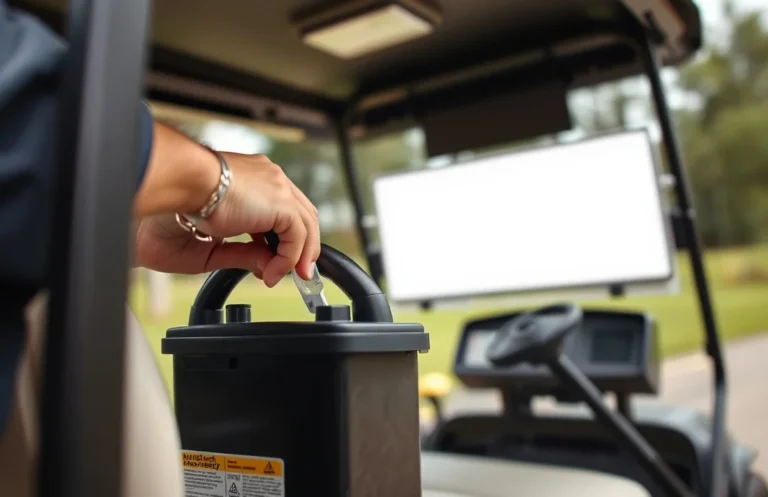
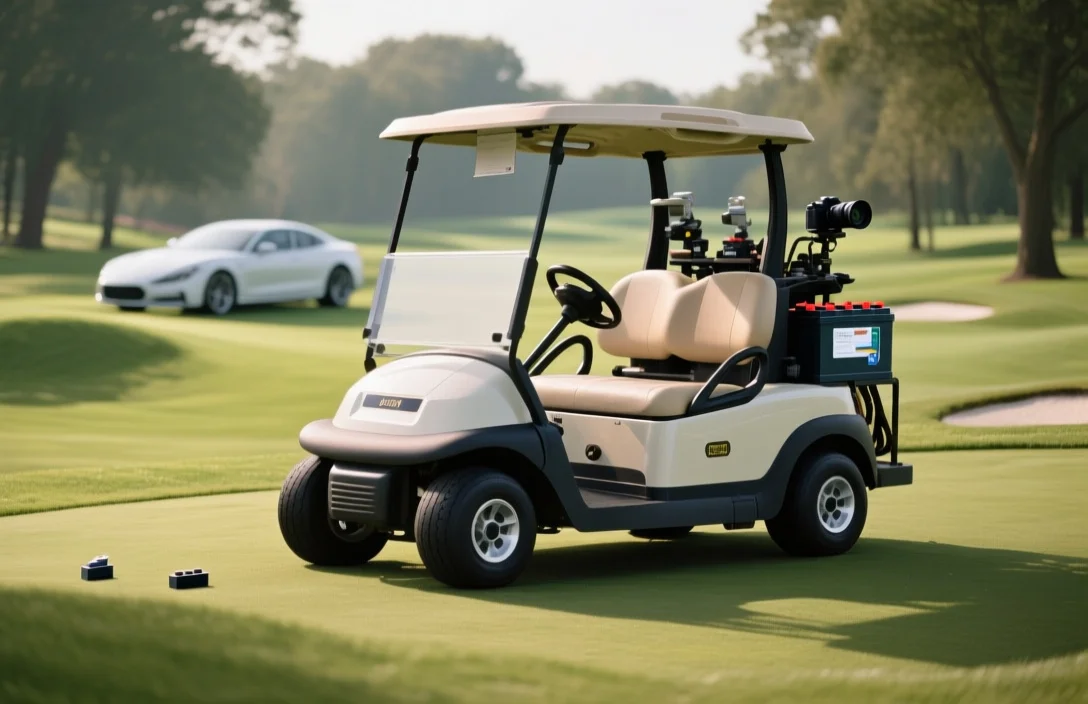
Can you use car batteries in a golf cart?
Short verdict: you can only use car batteries in a golf cart as a temporary emergency fix, because the pack voltage and usable amp-hour capacity are the specs that matter most. A common mistake is trusting CCA (cold-cranking amps) instead of Ah and depth-of-discharge. First check the cart voltage label or the charger output rating.
Car batteries in a golf cart are usable only temporarily and with limits: match the pack voltage exactly, use 3×12V for 36V or 4×12V for 48V, keep discharge under about 20 percent, and never rely on a car charger to replace a proper golf-cart charger.
One-line verdict
No, car starting batteries are not a safe long-term replacement for golf-cart batteries; they can power a cart in an emergency if you wire the correct number of 12 volt units in series, but expect much shorter runtime, rapid capacity loss, and charger incompatibility. Use car batteries only temporarily and only after matching voltage and amp-hour ratings, isolating and fusing the pack, and avoiding any regular charging with a standard automotive charger.
Top short caveats, in one line each:
| Common cart pack | Using 12V car batteries | Pack Ah equals |
|---|---|---|
| 36 volts | 3 × 12V batteries in series | Ah of a single battery |
| 48 volts | 4 × 12V batteries in series | Ah of a single battery |
Safety warning: Never mix old and new batteries, never mix different Ah or chemistries in a series string, ensure venting and fusing, and avoid charging a series pack with an automotive alternator or single-bank car charger unless you know the charger matches the pack design.
For short-term emergency use, match voltage and Ah, put batteries in series only, secure and fuse connections, and charge the pack only with a compatible multi-stage charger as soon as possible. For regular use, replace with proper deep-cycle or lithium options instead of relying on car batteries.
Car vs golf batteries
You can use car batteries in a golf cart only as an emergency, short-term fix, never for regular service. Car (SLI) batteries are built for high-current, short bursts to start engines, while golf-cart batteries are deep-cycle units built to deliver sustained current and many partial discharges.
SLI vs deep-cycle differences are the reason. SLI batteries have thin plates for high cold cranking amps and a steep voltage drop under sustained draw. Deep-cycle batteries have thick plates, a flatter discharge curve, much higher recommended depth of discharge, and far higher cycle life when used as designed.
| Spec | Car (SLI) | Golf-cart (Deep-cycle) |
|---|---|---|
| Primary function | Short, high-current starts | Sustained discharge for traction/loads |
| Typical cell/battery sizes | 12V group sizes, high CCA | 6V GC2, 8V, or 12V deep-cycle; higher Ah per unit |
| Ah vs CCA | CCA matters, Ah low relative to deep-cycle | Ah rating and usable DoD matter, CCA irrelevant |
| Depth of discharge (DoD) | Designed for very low DoD, 10-20% typical | Designed for 50% or more usable DoD |
| Cycle life | Low if regularly deeply discharged | High when cycled within spec |
| Discharge curve | Steeper voltage sag under load | Flatter, more usable energy at working voltage |
Pack voltage rules, briefly: most golf carts use 36V or 48V packs. Three 12V batteries in series give 36V, four 12V give 48V. If you mix battery types or ages in series you risk uneven charging and rapid failure.
Charging matters. A car battery charger is tuned for SLI charge profiles and shorter absorption, and it often lacks proper multi-stage bulk/absorb/float and equalization used for flooded deep-cycle packs. Using the wrong charger will shorten battery life or damage cells.
For example, a 12V 50Ah car battery stores about 600 Wh (12×50). Three in series give 1800 Wh nominal at 36V, but usable Wh depends on safe DoD. Using SLI batteries, usable DoD is much lower, so runtime will be far less than a deep-cycle pack of the same Ah.
Recommended alternatives: proper 6V GC2 deep-cycle flooded strings for lowest cost per cycle, AGM for maintenance-free flooded replacement, or LiFePO4 conversions for much longer cycle life but higher upfront cost. Choose based on budget, maintenance willingness, and lifetime needs.
Voltage and pack examples
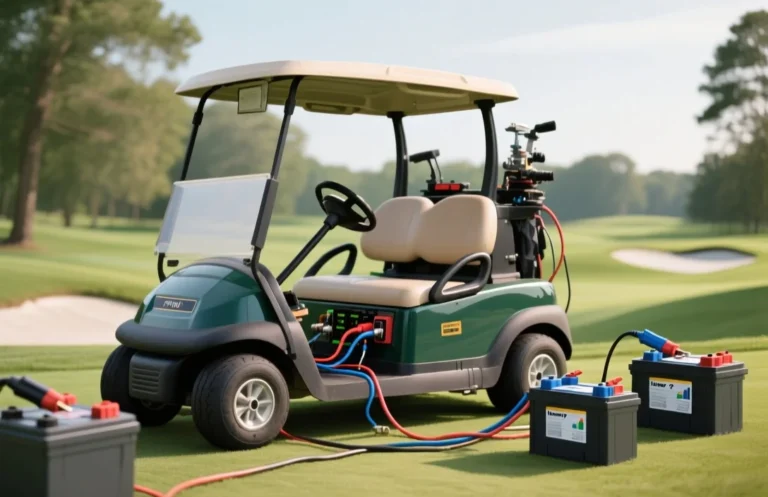
Yes, you can run a golf cart on car batteries only in an emergency, but the pack voltage must match the cart exactly and the trade-offs are real. Common golf cart systems are 36 volts and 48 volts, which means you must wire the correct number of batteries in series: 36V = 3 × 12V, 48V = 4 × 12V (or equivalent 6V/8V packs).
| Cart system | 12V batteries (series) | 6V batteries (series) | 8V batteries (series) |
|---|---|---|---|
| 36 volts | 3 × 12V | 6 × 6V | Not common |
| 48 volts | 4 × 12V | 8 × 6V | 6 × 8V |
Series wiring adds voltages while keeping amp-hour capacity the same, so three 12V batteries at 50 Ah in series give a 36V, 50 Ah pack. Parallel wiring raises amp-hours but must only be done with identical batteries by age, capacity, and state of charge to avoid current imbalances and premature failure.
For example, three 12V batteries rated 50 Ah produce 36V × 50 Ah = 1800 Wh. If you must use car batteries, calculate pack Wh and compare to the cart manual to estimate how far the temporary pack will take you, and plan to replace them with proper deep-cycle batteries as soon as possible.
Capacity, wattage, runtime
One 12 volt automotive starting battery typically contains far less usable energy than a 6 volt deep cycle GC2, so swapping car batteries into a golf cart will usually cut runtime and shorten battery life. The math is simple: watt-hours give the true stored energy and runtime is energy divided by load.
Formula: Wh equals V times Ah. For batteries in series, pack Wh equals the pack voltage times the series string Ah, because series adds voltage while Ah stays the same.
For example, using round example ratings: a 12 V car battery at 50 Ah gives 600 Wh; a 6 V GC2 deep-cycle at 225 Ah gives 6 × 225 = 1350 Wh. At an 800 W continuous load, the 12 V battery yields about 45 minutes, the 6 V GC2 about 1 hour 40 minutes.
| Item | V | Ah | Wh | Runtime at 800 W |
|---|---|---|---|---|
| 12 V car battery (example) | 12 | 50 | 600 | 0.75 h (45 min) |
| 6 V GC2 deep-cycle (example) | 6 | 225 | 1350 | 1.69 h (1 h 41 min) |
| 36 V pack, 3×12 V @50 Ah (series) | 36 | 50 | 1800 | 2.25 h (2 h 15 min) |
| 36 V pack, 6×6 V @225 Ah (series) | 36 | 225 | 8100 | 10.1 h (10 h 7 min) |
Charger compatibility & rules
No, you should not use car (SLI) batteries in a golf cart for regular use; they can work only as an emergency, temporary substitute if the pack voltage is correct and you accept much shorter life and reduced range. Golf-cart batteries need charger profiles that match deep-cycle chemistry and pack voltage, not the short high-current cranking profile car chargers provide.
Use multi-stage, float-capable chargers for flooded and AGM lead-acid batteries, and a proper CC/CV charger sized for the pack voltage for LiFePO4 packs that also has a compatible BMS. Verify the charger is rated for the pack voltage (36V, 48V, etc.), the correct chemistry setting, and the manufacturer recommended bulk, absorb, and float voltages before connecting.
| Battery type | Charge method | Typical settings to confirm |
|---|---|---|
| Flooded lead-acid | Multi-stage with equalize option | Bulk/absorb higher voltage, float lower voltage, equalize allowed per manual |
| AGM | Multi-stage, limited equalize | Moderate absorb voltage, conservative float, avoid high equalize |
| LiFePO4 | CC/CV charger + BMS | Correct CV cutoff for cell count, BMS balancing, no lead-acid equalize |
Automotive chargers and jump-starters are dangerous or ineffective because they are designed for 12V SLI batteries and for short high-current events, not repeated deep discharge cycles. They may not provide absorb or float stages, can overheat plates in deep-cycle batteries, and can bypass or trigger LiFePO4 BMS systems.
Safety: mismatched batteries, wrong charger voltages, or using jump-starters can cause overheating, plate damage, hydrogen gas build-up, BMS trips, and rapid capacity loss. Verify charger specs against the battery manual every time.
Wiring, installation & safety
You can use 12 volt car batteries in a golf cart only as a short term emergency fix, not as a permanent replacement, because car SLI batteries are not built for repeated deep discharge and will lose capacity quickly and can overheat. If you proceed, wire identical batteries in series to meet pack voltage, fuse close to the pack positive, size cables for the motor current, and ventilate the battery bay for hydrogen during charging.
Match age, Ah and type exactly, do not mix used and new batteries, and do not mix chemistries. Batteries in a series string must have the same nominal voltage and Ah rating so the string charges and discharges evenly; mismatched cells will cause accelerated failure and possible heating.
| Pack voltage | Common config | Example Wh (12V 50Ah) |
|---|---|---|
| 36V | 3 × 12V (in series) | 36V × 50Ah = 1800 Wh |
| 48V | 4 × 12V (in series) | 48V × 50Ah = 2400 Wh |
Fuses and main disconnects must be installed at the battery positive, as close to the first terminal as possible. Size the fuse so it is slightly higher than the controller or motor continuous current rating; for example, if your motor can draw 5000 watts at 48V, expect continuous current near 105 amps so choose a fuse/breaker rated just above that continuous current and follow the controller manual for exact spec.
Cable gauge should be chosen from calculated pack current, not guesswork; compute I = watts / voltage, then pick an AWG with appropriate continuous amp rating plus 25 percent safety margin and keep cables short. Use insulated terminal adapters, quality crimped lugs, and torqued connections, and secure batteries with proper hold-downs so terminals cannot short against metal.
Warning: flooded car batteries can produce hydrogen while charging; always ventilate the compartment and avoid sparks or smoking near batteries.
Final notes on warranty and legality: converting to car batteries commonly voids OEM battery and possibly controller warranties, and insurers may require inspection after modifications. Check the cart manufacturer recommendations, contact your insurer if you plan a long term conversion, and prefer a professional shop inspection before regular use.
Emergency: if you must
You can, in an emergency, run a golf cart with 12 volt car (SLI) batteries but only in series, only temporarily, and only if you accept much-reduced range and near-certain premature battery failure. Use three 12V batteries for a 36V system and four 12V batteries for a 48V system, match age and Ah closely, fuse the pack, limit discharge, and return to proper deep-cycle batteries as soon as possible.
Quick Summary
No, you generally should not use car batteries in a golf cart without modifications, because car batteries are 12 volt starter types, not deep-cycle.
Frequently Asked Questions
Can you use car batteries in a golf cart?
You can only use car batteries if the pack voltage and capacity match the cart, for example 36V = 3 x 12V and 48V = 4 x 12V, but that does not mean it is recommended. Car batteries are usually starting batteries, not deep-cycle, so expect much shorter life if you substitute them.
Will car batteries overheat if I put them in a golf cart?
You can see higher surface temperatures when a starting battery is used for continuous discharge, so monitor temps and stop use if the battery surface exceeds 50 C (122 F). Also check the manufacturer temperature limits and avoid sustained high discharge currents that the battery was not designed for.
How long will a car battery run a golf cart?
You can estimate runtime by dividing battery capacity in amp hours by the cart current draw, runtime (hours) ≈ capacity (Ah) / load (A), so a 12V 60Ah battery at a 20A draw gives about 3 hours. Remember actual runtime falls with age, higher speeds, and heavy loads.
Is it safe to replace golf cart batteries with car batteries?
You can physically replace them in some setups, but it is not generally safe because car batteries have lower cycle life and different charge characteristics, so they can be damaged or vent; typical golf cart batteries are 6V deep-cycle at 200+ Ah while car batteries are often 12V 40-100 Ah. Always check the cart manual and charger compatibility before changing battery type.
What common mistakes do people make when trying to use car batteries in a golf cart?
You can avoid failures by not mixing voltages or battery types, for example replacing a 6V 225Ah deep-cycle with a 12V 50Ah starting battery is a mismatch; mixing 12V starting batteries to make 36V without matching Ah and age is a frequent error. Also confirm physical fit, terminal layout, and that the charger supports the battery chemistry before buying.