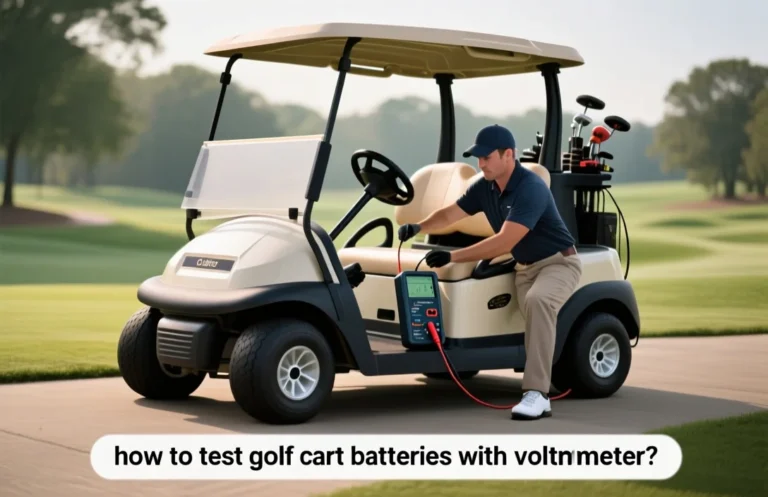

How to test golf cart batteries with multimeter?
Most golf carts use 6V or 8V lead-acid batteries wired into 36V or 48V packs, so voltage is the single most important spec when testing. A common mistake is reading a battery while it is still charging or right after use. First check the multimeter setting, set it to DC volts and a range above the battery nominal voltage.
How to test golf cart batteries with a multimeter: disconnect chargers and rest the pack 6 to 12 hours, set the meter to DC volts, measure each battery open-circuit, compare to nominal (about 6.3V for 6V, 8.4V for 8V, 12.6V for 12V), then perform a simple load check if voltage is low.
Why use a multimeter
A multimeter gives a direct, immediate measure of a golf cart battery string voltage and can reveal gross state of charge, open circuits, bad connections, and blatant cell failures. It cannot measure true capacity, internal resistance precisely, or electrolyte specific gravity, so it is a first-line diagnostic not a final health certificate.
A steady resting voltage tells you approximate state of charge and whether the battery string is behaving as one continuous source.
For example, a fully charged 6 volt or 8 volt battery will read significantly higher than a deeply discharged one, and a large mismatch between series batteries shows imbalance or a bad unit.
Limitations matter. A multimeter cannot tell you how many amp-hours the battery will deliver under load, and it cannot replace a hydrometer for flooded lead-acid specific gravity readings or a proper load tester for voltage sag under rated current. Use a multimeter first to decide if further testing is worth the time and cost.
Problem: Low resting voltage
Symptom: The multimeter shows a low voltage on the battery string after the cart has sat for several hours, lower than expected for the battery type. Cause: Deep discharge, self-discharge from old batteries, or poor charging can leave resting voltage low, but voltage alone does not prove low capacity. Fix: Charge the string fully, let it rest, then remeasure each battery; if voltage returns to expected levels the issue may have been charging, otherwise move to a load test or conductivity test.
For practical decision-making, if a fully charged and rested battery still reads well below nominal, plan on further testing with a load tester or hydrometer for flooded cells, or prepare to replace batteries showing persistent low voltage despite good charging and connections.
Problem: Excessive voltage sag under motor load
Symptom: Voltage drops sharply when the cart is engaged, as measured with the multimeter while someone runs the cart under typical load. Cause: High internal resistance from sulfation, plate damage, loose terminals, or poor interconnects causes rapid voltage collapse under load. Fix: First tighten and clean all connections, then charge and retest; if sag persists, perform a proper load test or use a conductance tester to quantify internal resistance and decide on replacement.
Problem: Unequal voltages in a battery string
Symptom: One or more batteries in the string measure significantly different voltages than the others with the multimeter. Cause: A single weak or failing battery, bad cell, or poor inter-battery cable/terminal connection can create imbalance and reduce overall pack performance. Fix: Isolate and test each battery individually after charging, swap or equalize as appropriate; replace any battery that cannot hold voltage or that shows obvious damage.
Safety and prep
Wear eye protection, acid-resistant gloves, and remove rings or metal jewelry before touching any golf cart battery terminal. Always power the cart down, disconnect any charger, and work in a well ventilated space to avoid sparks near batteries that can emit hydrogen gas and contain corrosive electrolyte.
Identify your pack voltage
Most golf-cart packs are made from 6 volt, 8 volt, or 12 volt deep cycle batteries tied in series to reach the pack nominal voltage, for example 36 volts or 48 volts. Amp hours, printed on each battery, set the capacity; watt hours equal pack voltage times amp hours and give a direct measure of usable energy.
Read the label on each battery for three key specs: voltage (V), amp hours (Ah), and chemistry type (flooded, AGM, gel, or lithium). The label may also show a date code or manufacture week, and sometimes recommended charge voltage and reserve capacity, which are useful when comparing cells in a pack.
Check these physical signs before measuring: clean terminals, no heavy corrosion, no swollen cases, and secure interconnects between batteries. If any cell shows physical damage or a leaking vent, mark it for replacement rather than trying to salvage it with tests alone.
| Single battery voltage | Common series counts to reach pack voltage (examples) |
|---|---|
| 6 V | 6 in series = 36 V, 8 in series = 48 V |
| 8 V | 6 in series = 48 V |
| 12 V | 4 in series = 48 V |
Meter tools and limits
A good digital multimeter with a DC voltage range above your pack voltage is the essential tool: it accurately reads open circuit and under-load voltages and checks cable continuity. For measuring currents, use a clamp meter or a meter with a high-current shunt, because most handheld DMMs cannot safely measure golf cart charging or motor currents directly.
Safety first: wear eye protection and insulated gloves when probing battery terminals, work in a ventilated area for flooded cells, and never switch meter to an AC or resistance range while connected to a live battery. Expect fuses to blow if you try to measure high DC current through a standard DMM input.
| Item | Amount / Specification | Notes |
|---|---|---|
| Digital multimeter (DMM) | DC volts to at least 60 V, auto or manual range | Must read DC voltage accurately; true RMS not required for DC tests |
| Leads / probes | Shrouded, rated ≥ pack voltage | Good insulation, firm clips or probe tips reduce slip and shorts |
| Clamp meter (optional) | DC clamp capable, current range matching charger/motor | Measure charge/discharge current without breaking circuit |
| IR thermometer (optional) | ±2 to 3°C accuracy | Spot hot cells, loose terminals or overheat after load/charge |
| Hydrometer (flooded cells, optional) | Glass or plastic, specific gravity scale | DMM cannot measure electrolyte SG; needed for flooded lead-acid condition |
Set the DMM to DC volts (V⎓ or VDC), choose a range above the pack voltage, and confirm probe polarity before touching terminals. Use the resistance or continuity function only with the battery disconnected, because applying resistance checks to a live battery can damage the meter. Never try to measure pack charging current through the DMM current jack unless the meter’s fuse and rating explicitly cover the expected amps.
A multimeter measures voltage, continuity, and low-resistance reasonably well, but it cannot determine true state of charge, capacity in amp-hours, sulfation, or cell-specific gravity on sealed batteries. You can estimate internal resistance by doing a controlled load test and calculating voltage drop, but that requires a known load and careful procedure and is not a direct single-meter readout.
Resting voltage test
A correct open circuit voltage reading requires the battery to sit without charge or load so surface charge fades and the voltage stabilizes. For golf cart deep cycle lead acid batteries, allow at least 6 to 12 hours after charging or driving standby loads, and up to 24 hours for the most accurate reading; if unsure, follow the battery maker’s recommended rest time.
Safety first: wear eye protection, remove jewelry, make sure the charger and vehicle are switched off, and keep metal tools away from terminals. If a battery is swollen, leaking, very hot, or smells strongly of sulfur, stop and get professional help rather than probing it yourself.
Under-load and series tests
Under-load testing shows how a golf cart battery pack actually behaves under real current draw, and comparing pack voltage before, during, and after a load reveals weak batteries in a series string. Use the cart motor or accessories as a practical load, or a dedicated load tester for controlled results, while measuring with a multimeter at the pack and across each battery.
Safety first: wear eye protection and gloves, remove jewelry, and keep tools clear of terminals. Disconnect the charger before testing, and do not short terminals with the multimeter probes or metal tools.
Interpreting results
A healthy golf cart lead acid battery cluster will show consistent resting voltages near the expected per-cell value, while a weak battery, sulfated plates, or poor connection will create low or uneven voltages and rapid voltage collapse under light load. Use resting voltages, series comparisons, and simple dynamic checks with your multimeter to decide whether to recharge, equalize, rewater, repair connections, or replace a battery.
Replacement trigger: any battery that repeatedly reads significantly below packmates after proper charging, or any cell that measures far below expected per-cell voltage, should be considered for replacement rather than prolonged repair. When in doubt, get specific gravity or conductance testing before spending time on repeated charging or equalization.
Charging, maintenance, replacement
To test golf cart batteries with a multimeter, measure each battery’s open-circuit voltage after a full charge and then measure the voltage again while applying a realistic load, and compare the difference and per-battery voltages to the battery’s nominal rating. A battery that reads low at rest or collapses significantly under load is a candidate for watering, equalization, or replacement, depending on the cause.
After testing, use the results to decide maintenance or replacement. If a battery shows low resting voltage but recovers after a full charge and equalization, it may only need watering and equalization; if it collapses under load or differs from others by a large margin, plan replacement and check warranty status.
Quick Summary
Use a digital multimeter to check each golf cart battery’s voltage at rest and under load, then compare to manufacturer specifications for diagnosis.
Frequently Asked Questions
How do I test a golf cart battery’s voltage with a multimeter?
You can set a digital multimeter to DC volts and place the red probe on the positive terminal and black on the negative, measuring the battery with the cart off and after it has rested. A fully charged 12V battery reads about 12.6 to 12.8 volts, and a 6V battery reads about 6.3 volts at rest.
Can I use a regular digital multimeter to test 6V, 8V, or 12V golf cart batteries, and what range should I pick?
You can use most handheld digital multimeters, but make sure the meter is set to DC volts and the range is higher than the battery bank, for example the 20V range for single 12V batteries or banks. Set the meter to a DC voltage range above the battery voltage, commonly the 20V range.
How can I detect a heat-related or bad cell problem with a multimeter when testing golf cart batteries?
You can measure each battery or cell at rest and compare voltages, and if one cell or battery reads noticeably lower than the others under the same conditions suspect a weak cell; also avoid touching batteries that are hot. If a cell or battery is more than 0.2 volts lower than its neighbors at rest, it likely indicates a weak or failing cell.
How long does a proper multimeter test take and when should I measure for an accurate state-of-charge?
You can get a quick voltage reading in seconds, but for an accurate open-circuit state-of-charge wait after charging or use, because surface charge skews readings. Wait about 6 to 12 hours after charging or heavy use before taking a true resting voltage.
How do I avoid buying a bad used golf cart battery when testing with a multimeter?
You can check each battery individually, look for consistent voltages across the bank, and do a simple load check by measuring voltage while the cart draws current; avoid units with low resting voltage or large differences between batteries. A single 6V battery reading below about 5.9 volts at rest, or a 12V bank with cells that differ by more than 0.2 volts, is a strong warning to walk away.