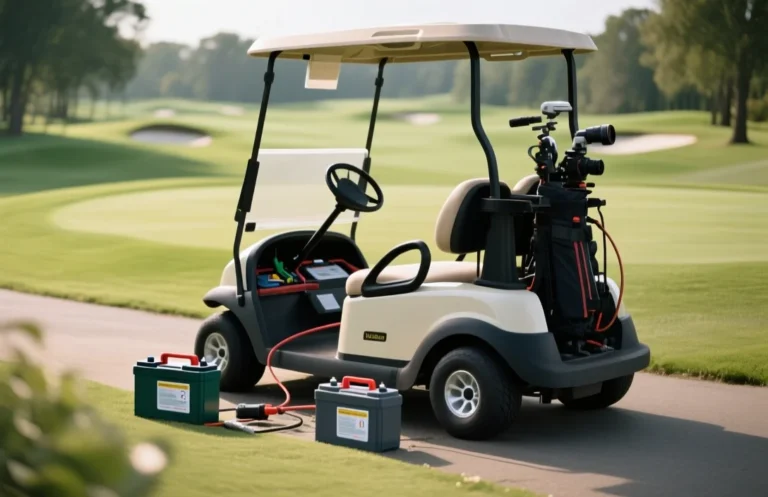

How to tell which golf cart battery is bad?
About one weak cell can ruin an entire golf cart battery bank, and the spec that matters most is cell voltage combined with specific gravity for flooded batteries. A common mistake is trusting a resting voltage alone. First check the battery label for voltage and the date code, then verify the charger is set to the correct pack voltage, for example 36V or 48V.
Golf cart battery problems show in voltage and load behavior. Check each battery’s resting voltage, perform a 10-second load test, and for flooded cells read specific gravity; voltages more than 0.5V lower than neighbors, specific gravity below 1.200, or visible swelling indicate a bad battery.
Immediate warning signs
If a single golf cart battery is failing you usually notice weak acceleration or slow startup, visible physical damage or leakage, and unusual heat or swelling. At the first sign, stop using the cart and follow safety steps before any inspection or testing.
Slow startup or weak pull shows up as sluggish acceleration, reduced hill-climbing ability, and shorter distance per charge. If the cart feels underpowered even after a full charge cycle, one or more batteries may be weak or have a bad connection; that behavior is one of the fastest ways to detect a problem while the cart is in use.
Visible damage or leakage includes cracked cases, bulging tops, white or green crust at terminals, wetness around vent caps, or acid smell. Any sign of leakage is a safety issue, avoid skin or eye contact and do not run the cart until the battery is isolated and inspected by someone with appropriate PPE.
Heat and swelling are serious, especially when a battery is hot to the touch after short use, the case looks warped, or the vent caps have popped. Swollen batteries can rupture or leak; do not try to force them back into place, and do not charge a battery that is visibly swollen.
Check resting voltage
Measure each battery’s open-circuit voltage after the pack has been idle and the charger is disconnected; the battery with a consistently lower resting voltage than the others is very often the bad one. Comparing voltages across the series reveals the weak link because batteries in series should sit at almost the same open-circuit voltage when healthy and rested.
Common measurement mistakes to avoid:
Specific gravity check
A hydrometer shows which flooded lead-acid cell is weak by measuring each cell’s electrolyte specific gravity, so a single cell with a clearly lower reading than its neighbors usually indicates a bad cell, sulfation, or a shorted plate. If every cell measures similarly low, the battery pack is likely undercharged rather than one failed cell.
When to use a hydrometer
Only use a hydrometer on flooded lead-acid golf cart batteries that have removable vent caps and visible electrolyte, do not use it on sealed AGM, gel, or lithium cells. For the most telling results, test after the charger has finished and the battery has had time to settle, because charging and temperature affect specific gravity.
Hydrometer testing is the right next step when you have already checked voltage and suspect imbalance between cells, or when a particular battery in the pack shows reduced runtime. If you cannot fully charge the pack first, you can still test, but interpret uniformly low readings as possibly due to state of charge rather than a single bad cell.
Interpreting variation: Small differences between adjacent cells are normal, but a single cell that is noticeably lower than the rest is suspect for internal shorting, plate shedding, or heavy sulfation. Uniformly low numbers across all cells point to undercharge or a charger problem, not an individual cell fault.
Load testing procedures
A battery that looks healthy at rest can fail under load, so the quickest way to tell which golf cart battery is bad is to apply a realistic discharge and watch for voltage collapse or dramatically shortened runtime. A good battery holds near its nominal voltage under a steady load and recovers after rest; a bad battery drops sharply, warms, or refuses to deliver expected amp-hours.
Safety first: disconnect chargers, remove jewelry, wear eye protection and gloves, and work in a well ventilated area. Stop tests if a battery gets hot, emits strong odor, leaks fluid, or the case bulges; those are replacement triggers, not repairable faults.
Bench load tester steps
A bench load tester gives a controlled, known current so you can compare batteries one by one. You need the tester sized for your battery voltage, a reliable voltmeter, and a timer; do not try to load a battery with equipment that exceeds its rated discharge current.
Run the bench test after the battery has been rested and surface charged to full. Apply the specified load for the recommended test duration from the tester manual, record the starting voltage, voltage during the test at regular intervals, and the voltage immediately after removing the load. A healthy battery drops modestly under load and then rebounds; a bad battery falls steeply and shows little recovery.
On-cart runtime and under-load check
Testing while the battery is in the cart replicates real world stresses including starter draws, controller losses, and wiring issues. Drive the cart under a typical load condition, note how long it runs before voltage sag or performance loss, and check terminal voltage under load with a meter clamped to the battery while someone operates the throttle.
For example, run a single hole or fixed-distance loop and time it, then swap suspect battery to another position if practical and repeat. If one battery causes immediate strong sag, shorter runtimes, or trips the charger cutoff after discharge, it is likely failing. Log voltage at start, during steady drive, and after rest; patterns tell you whether the issue is poor capacity or internal resistance under load.
Voltage collapse is when terminal voltage falls rapidly under a normal load and does not rebound sufficiently after the load is removed; that behavior identifies batteries that have lost usable capacity or have internal shorts and need replacement.
| Test | Good battery shows | Bad battery shows |
|---|---|---|
| Voltage under load | Small, steady drop and quick recovery | Sharp drop, slow or no recovery |
| Runtime on a loop | Expected minutes per charge | Significantly shorter runtime |
| Temperature | Mild warmth | Hot case or hot venting |
Conductance and impedance testing
Conductance and impedance meters let you find the weak golf cart battery by measuring how easily current flows through each cell, usually reporting a conductance value or a State of Health percent that falls as internal plate area, active material, or connections degrade. A significantly lower conductance or higher internal resistance on one battery, compared with the rest of the pack, is a clear indicator that battery is the problem and likely needs replacement or warranty inspection.
| Metric | Typical reading shown | What it means for internal health | Quick action |
|---|---|---|---|
| State of Health (SOH) % | Meter reports percent | Lower percent means less active plate area or increased sulfation; relative comparison is key | Check against OEM/warranty threshold; consider replacement if markedly below peers |
| Conductance | Siemens or arbitrary scale | Lower conductance equals higher internal damage or poor connections | Clean terminals, retest, then isolate battery for warranty or replace |
| Internal resistance | milliohms | Higher resistance means heat losses and reduced current delivery | Verify with load test; replace if high and symptomatic |
| Pack variance | Difference between highest and lowest | Large variance indicates one or more weak batteries that shorten pack life | Target outliers first for swap or warranty claim |
Interpreting numbers requires context, because meters and manufacturers use different scales and thresholds. Treat the meter as a diagnostic indicator: a single low reading that is consistent across repeats and much lower than other batteries is usually reliable evidence of a bad battery, but borderline readings need verification.
For example, if five batteries read similar conductance and one reads substantially lower, that one is the likely bad cell even if its open-circuit voltage looks normal. Record the readings, repeat the test after cleaning terminals, and if the low result persists within your warranty period, contact the supplier with the logged values.
Observe charging behavior
A failing golf cart battery reveals itself when it will not accept and hold charge like the others in the pack: it either refuses current, rapidly reaches a surface-charge voltage and then collapses after rest, or behaves differently during an equalization cycle. Watch how much current the charger supplies, how quickly pack voltage climbs, and whether individual batteries equalize or vent when expected.
Begin with safety: always wear eye protection, avoid sparks near flooded cells, and confirm your charger is set for the battery chemistry before testing. If a battery is hot, swollen, or leaking, stop testing and replace it rather than push with high-voltage equalization.
When charging behavior points to a bad battery, confirm with a hydrometer on flooded cells or isolated voltage checks per battery before replacing. If equalization does not bring batteries into balance or a cell vents heavily, plan to replace that battery rather than continue cycling the pack.
Buying and replacement rules
Replace a bad golf cart battery with one that matches the bank’s nominal voltage and amp-hour rating, and avoid mixing new and old batteries in the same string because age mismatch shortens life and causes uneven charging. If one battery shows clearly lower resting voltage or specific gravity than the others, replace that battery, and consider replacing the entire bank when multiple cells or batteries are aged.
Match voltage and amp-hour, exactly where possible. Check the battery label for nominal voltage (for example 6 volt or 8 volt), the Ah rating printed on the case, terminal type and physical dimensions so the replacement fits trays and cable lengths.
Replace by age and mismatch, not only by single-failure symptoms. If one battery fails but the rest are within two years of age, replacing just that battery is possible, but expect lower overall pack life. If the bank has mixed ages or more than one weak battery, replace the full bank to restore balanced capacity and charging behavior.
| Spec to check | Minimum action | Why it matters |
|---|---|---|
| Nominal voltage | Match exactly | Different voltages cannot be used in the same string safely |
| Amp-hour rating | Match same Ah or very close | Capacity mismatch causes uneven discharge and reduces life |
| Chemistry and terminals | Match type and terminal style | Charger settings and connections must be compatible |
| Age / date code | Prefer same age group | Older batteries will drag down newer ones |
Rule of replacement: a single clearly failed battery should be replaced promptly, but when two or more batteries are aged or show weak measurements, replace the entire bank.
Reconditioning versus replacement: equalization or desulfation can restore some flooded lead-acid batteries, but rebuilt batteries need matched cells and can void warranty. For AGM, gel, or suspect internal damage, replacement is the safer choice. If you consider rebuilding, weigh the cost of matched new cells, the skill needed, and the remaining warranty before proceeding.
Dispose or recycle old batteries through a licensed recycler or dealer to follow regulations and avoid environmental harm. Keep documentation of date codes and warranty claims, and never install a battery that is swollen, cracked, or leaking.
Quick Summary
Measure each battery’s open-circuit voltage, perform a load or hydrometer test, and compare results to the manufacturer’s nominal rating.
Frequently Asked Questions
How can I tell which golf cart battery is bad by checking voltage?
You can use a voltmeter, measure each battery at rest after charging, and compare readings; a 6V battery reading under 5.8V at rest or an individual battery more than 0.5V below the pack average is a strong sign it is bad.
How can I tell which golf cart battery is bad if one gets hotter than the others?
You can carefully feel or use an infrared thermometer after a short run, and if one battery is consistently about 10 degrees Celsius warmer than the other batteries that battery is likely failing and should be inspected immediately for internal shorting or charging faults.
How can I tell which golf cart battery is bad when the cart’s runtime drops?
You can run a capacity or amp-hour test, or measure voltage under a standard load, and if a single battery shows about 20 percent lower capacity or a voltage sag more than 0.5V under load it is likely the weak link shortening pack runtime.
How can I tell which golf cart battery is bad by visual or safety signs?
You can inspect each battery for cracks, leaks, swelling, heavy terminal corrosion, or a strong sulfur smell, and if you see a bulged or cracked case, visible electrolyte leakage, or more than 2 mm of corrosive buildup at a terminal stop using it and replace it immediately for safety.
How can I tell which golf cart battery to replace first and when should I buy a new one?
You can prioritize replacing the battery that fails voltage, load, or specific gravity tests, and consider replacement when a battery’s measured capacity is under 50 percent of its rated amp-hour capacity or when it repeatedly fails the basic tests, then buy a matched replacement to avoid mixing old and new cells.