How much does a golf cart battery weigh?
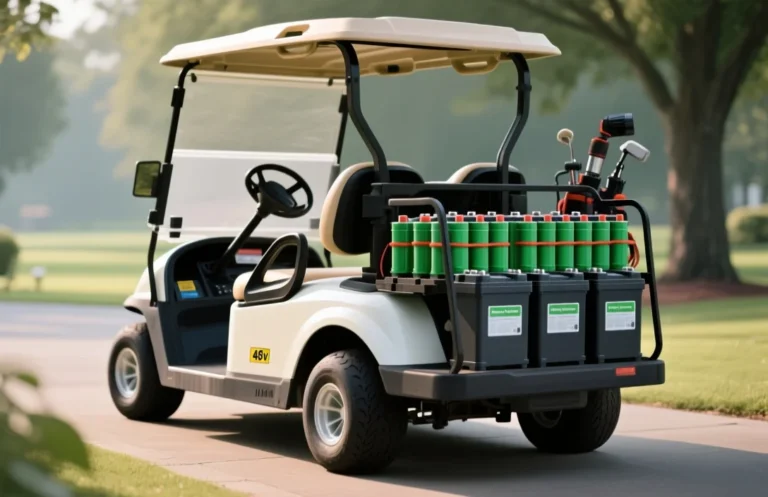
A single lead-acid golf cart battery often weighs around 60 to 70 pounds, and a full battery bank can easily top 300 pounds. Voltage and amp-hour capacity are the specs that matter most for compatibility and runtime, not just weight. A common mistake is choosing by case size or brand, so first check the battery voltage, Ah rating, and chemistry on the label.
Golf cart batteries typically weigh 50 to 100 pounds per battery depending on chemistry and capacity; a 36V pack made from six 6V lead-acid batteries commonly totals about 300 to 420 pounds, while lithium replacements often reduce pack weight by roughly 40 to 60 percent.
Typical golf cart battery weights
A single 6 volt deep cycle flooded golf cart battery commonly falls in the 55 to 80 pound range, while 8 volt and 12 volt deep cycle lead acid units typically sit between about 40 and 80 pounds depending on size and reserve capacity. Lithium‑ion modules used to build 36V or 48V golf cart packs are much lighter per amp-hour, often 15 to 40 pounds per module, so a full lithium pack can weigh roughly half to two thirds of an equivalent lead-acid bank.
Flooded lead-acid weight patterns are driven by plate size and electrolyte volume, so the classic GC2 6V golf cart cell is heavy because it contains large, thick plates and lots of sulfuric acid. The heavier the amp-hour rating, the thicker and more numerous the plates, and the larger the case. That makes high-capacity flooded cells the heaviest single items on many carts.
AGM and other sealed lead-acid batteries usually weigh very close to flooded equivalents of the same rated capacity, because they keep similar internal plates and roughly the same amount of active material, with only small weight differences from separators and internal construction. Expect sealed versions to be within about 5 to 10 percent of a flooded battery’s weight for the same rated amp-hours.
For example, a 48 volt system built from eight 6V flooded cells will weigh substantially more than a 48 volt lithium pack made from two or three modular LiFePO4 units, even when both systems have similar usable energy. Lithium cells deliver similar usable watt-hours at significantly lower mass, but the exact savings depend on cell chemistry and the battery management system hardware included.
| Chemistry | Common system voltage | Typical weight range (lb) | Notes |
|---|---|---|---|
| Flooded lead-acid (GC2 6V) | 6V | 55 – 80 | Heavier per AH, common in older carts |
| Sealed AGM lead-acid | 6V / 8V / 12V | 45 – 80 | Similar mass to flooded for same AH |
| Lithium‑ion (LiFePO4 modules) | 12V / modular 24V/48V | 15 – 40 per module | Lower weight per usable kWh, requires BMS |
Warning: heavy batteries require proper lifting technique and two-person handling or mechanical lifting. Dropping a battery can cause acid spills, case rupture, or personal injury.
Capacity, wattage, runtime for carts
Weight is not a reliable shortcut for runtime, because energy stored is Ah times nominal voltage, and that energy divided by your load gives hours of run time. Convert amp‑hours and voltage to watt‑hours, then divide by the continuous load and adjust for usable capacity and conversion losses to estimate runtime.
To get usable energy from a battery spec, multiply the battery bank nominal voltage by amp‑hours: Wh = V × Ah. For small cells mAh is the same idea, convert to Ah by dividing by 1000, then multiply by voltage to get Wh.
For example, with a 4800 Wh battery and a 500 W continuous draw, the raw calculation gives about 9.6 hours. Check the battery’s usable percentage and system efficiency before planning, because final runtime might be substantially lower after accounting for allowable depth of discharge and conversion losses.
Weight factors for carts
A golf cart battery’s weight depends mostly on chemistry and capacity, with flooded lead-acid packs typically much heavier than lithium packs of the same amp-hour rating, and pack configuration adding weight linearly as you stack cells or modules. Other strong influencers are plate thickness, the amount of electrolyte or water carried, casing material, and whether batteries are grouped in series or parallel.
Chemistry and internal construction change mass per unit of stored energy. Flooded lead-acid batteries contain thick lead plates and liters of sulfuric acid, which makes them heavy but inexpensive. Absorbent glass mat, gel, and sealed lead-acid have similar internal mass with small variations, while lithium iron phosphate or NMC cells use lighter metals and less liquid, so the pack weight per amp-hour is lower.
For example, replacing multiple small lead-acid cells with a single lithium module often lowers weight and simplifies mounting, but requires checking BMS, terminal layout, and cooling needs.
| Factor | How it changes weight | What to check on the spec sheet |
|---|---|---|
| Chemistry | Largest per-Ah difference | Type (flooded, AGM, LiFePO4), cell chemistry |
| Plate thickness | Increases mass and longevity | Plate gauge, cycle life, reserve capacity |
| Electrolyte & casing | Liquid and heavy casing add bulk | Wet/dry fill, case material, weight listed |
| Configuration | Series adds voltage, parallel adds capacity – both add weight | Pack voltage, cell count, Ah per battery |
| State of charge / water | SoC changes mass negligibly, water levels can add measurable mass | Recommended fill levels, terminal access, maintenance requirements |
Quick checks before you buy: confirm chemistry and listed weight, check Ah and voltage, confirm whether weight includes electrolyte or is dry, and verify casing and terminal layout for your cart. Warning: swollen or damaged batteries can be heavier or lighter due to lost electrolyte and are a safety risk; do not use compromised units.
Handling and range effects
Individual 6 volt deep-cycle lead-acid golf cart batteries commonly weigh on the order of 60 to 80 pounds each, so a typical 36 volt pack made from six of them will often total roughly 360 to 480 pounds. Lithium replacement packs are usually much lighter for the same usable energy, often cutting pack weight by a large fraction, but exact numbers vary by model so always check the battery datasheet or label.
For example, swapping a multi-hundred pound lead-acid pack for a lighter lithium pack can free up payload, reduce suspension stress, and improve acceleration and hill performance, but verify the lithium pack’s continuous discharge rating and usable capacity before assuming equal range.
Charger compatibility for carts
Battery weight usually tracks chemistry and capacity, and those two factors set what charger you need: heavier lead acid packs require lower continuous charge rates and ventilation, while lighter lithium packs typically need a charger that matches lithium voltage profile and a compatible BMS communication method. Match nominal pack voltage first, then capacity and chemistry when choosing current and charge algorithm.
Voltage is the first hard requirement. Most golf carts run on nominal 36 volt or 48 volt packs, so the charger must match that nominal voltage and the pack series configuration, not just the connector type. Using a charger with the wrong nominal voltage can damage cells or the vehicle electronics.
Chemistry settings and charge algorithms are the second requirement. Flooded lead acid, AGM, gel, and LiFePO4 all need different absorption, float, and cut-off behavior. For heavier lead acid banks, use chargers with a genuine lead acid profile and a low float voltage option; for lithium, use a charger or charger-with-BMS that supports lithium charge termination and under/over-voltage limits.
| Battery type | Relative weight | Charger notes |
|---|---|---|
| Flooded lead acid | Heavy | Use lead acid profile, low C-rate bulk/absorb, needs ventilation and charge limiting to avoid gassing. |
| AGM / Sealed lead acid | Moderately heavy | Similar profile to flooded but lower gassing; float maintenance matters, avoid excessive current for long life. |
| LiFePO4 / Lithium | Light to medium | Require lithium profile, BMS coordination, can accept higher C-rates if manufacturer allows, less ventilation but thermal monitoring still needed. |
Checklist, before you buy: confirm pack nominal voltage, required chemistry profile, manufacturer max charge current or C-rate, and whether the pack has a BMS that needs charger communication.
Warning: Do not substitute a charger because it fits the plug. Wrong voltage, wrong chemistry profile, or excess charge current will reduce life and can create heat hazards. Always verify the battery maker’s specs when weight or chemistry changes.
Safety, heat, swelling, storage
Most individual golf cart batteries weigh roughly 50 to 80 pounds, depending on voltage, case size, and chemistry; complete battery banks for a 36V or 48V cart commonly total several hundred pounds. Exact weight varies widely, so always confirm the sticker on the battery or the cart manual before lifting or transporting.
For example, if a single 6V battery that normally nests flat in the tray begins to bulge, shows venting residue, or no longer reaches acceptable voltage under load, remove it and replace the unit rather than risking a cascade failure in the bank. Confirm replacement weight and mounting dimensions from the label so the new battery fits safely and the cart’s weight distribution remains correct.
Buying, transport, troubleshooting for carts
A single deep cycle golf cart battery commonly weighs roughly 50 to 80 pounds, while a full lead-acid battery bank installed in a cart usually adds up to several hundred pounds total depending on voltage and how many batteries the pack uses. Lithium replacement packs for the same voltage are typically much lighter, often reducing total pack weight by a large percentage, but exact weights vary by model so always confirm the spec label before buying or moving.
Before purchase or removal confirm these hard facts on the battery label and spec sheet:
| Battery type | Single unit weight (typical) | Full cart bank (typical) |
|---|---|---|
| Lead-acid, 6V deep cycle (GC2 style) | 50 to 80 lb | ~300 to 480 lb for six batteries (36V systems vary) |
| Lead-acid, 8/12V options | 40 to 120 lb depending on size | 200 to 500+ lb depending on count and voltage |
| Lithium replacement packs (48V or equivalent) | varies widely, often 30% to 70% lighter than equivalent lead-acid | commonly 100 to 250 lb but check exact pack specs |
Safety warning: total cart battery weight can exceed what two people can lift safely, and terminals carry dangerous current. Use mechanical lifting equipment, nonconductive straps, and disconnect the charger before working on the pack.
Safe lifting and moving, step by step:
Recommended gear for transport: heavy-duty dolly with wheel locks, rated lifting straps or harness, a shop hoist or come-along for very heavy packs, insulated gloves, and eye protection. Use a nonconductive pad or shims if the tray has corrosion or gaps that could stress the case.
Troubleshooting sagging voltage or poor range where weight matters:
If any weight, dimension, or terminal detail is missing from the seller or label, delay the purchase until you get exact specs. Confirming those numbers prevents fitment errors, unsafe lifts, and range problems after installation.
Quick Summary
Golf cart battery weight varies by chemistry and voltage, with individual batteries typically ranging roughly twenty to eighty pounds each depending on type.
Frequently Asked Questions
How much does a typical lead-acid golf cart battery weigh?
You can expect a standard 6V deep-cycle lead-acid golf cart battery to weigh about 60 to 75 pounds (27 to 34 kg) each, depending on construction and capacity.
How much does a lithium golf cart battery weigh compared with lead-acid?
Lithium replacements are significantly lighter, typically about 40 to 70 percent lighter than an equivalent lead-acid battery, so a lithium pack that replaces a 6V battery often weighs around 20 to 40 pounds (9 to 18 kg).
Does the weight of a golf cart battery affect charger compatibility or how I should charge it?
No, weight does not determine charger compatibility, you must match the battery voltage (6V, 8V, or 12V) and amp-hour rating to the charger and use the manufacturer recommended charge profile.
Is it normal for a golf cart battery to get hot while charging and how hot is unsafe?
A slight warmth during charging is normal, but if the surface temperature rises above 120°F (49°C) or the battery feels very hot to the touch, stop charging and inspect for ventilation, overcurrent, or battery failure.
How can I tell by weight or physical signs when to replace my golf cart batteries, and what buying mistake should I avoid?
You should consider replacement when capacity falls to about 50 percent or after about 3 to 5 years of typical lead-acid use, and do not buy solely because a battery is lighter – always verify voltage, amp-hours, dimensions, and BMS/charger compatibility before purchasing.