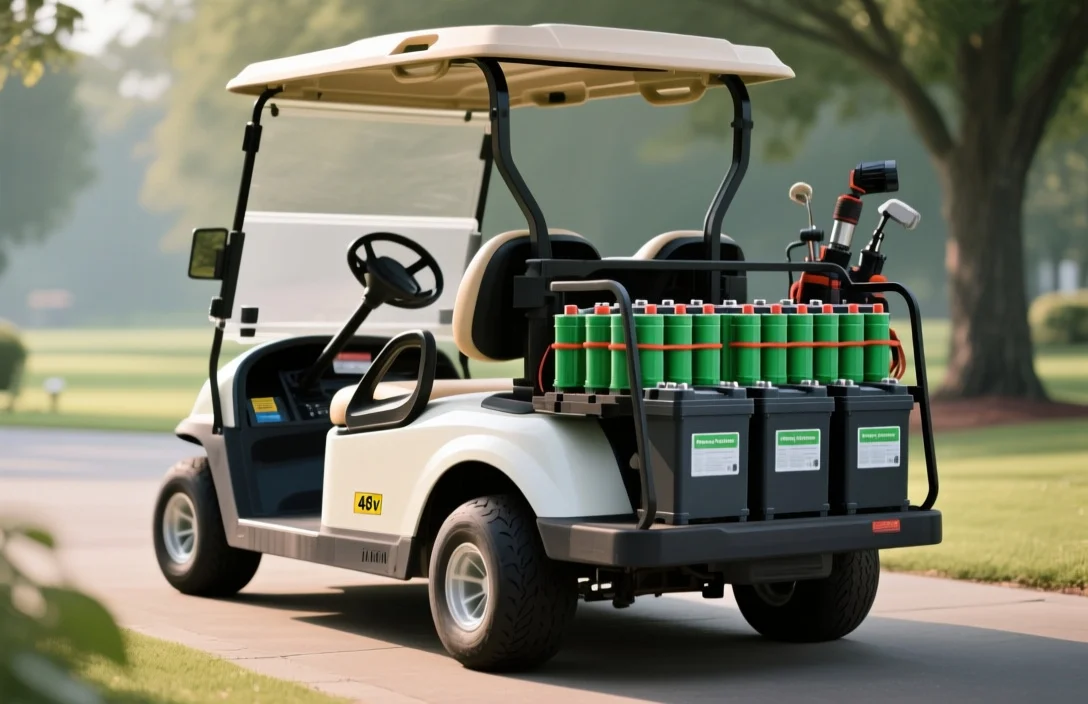
How many batteries in a 48v golf cart?
Most 48 volt golf carts are built from several smaller batteries wired to add up to 48 volts, and the spec that matters most is the pack voltage and amp-hour rating. A common mistake is assuming one physical battery equals the pack voltage. Check the battery label or measure the total pack voltage with a multimeter first.
48V golf cart batteries are commonly arranged as 8 × 6V, 6 × 8V, 4 × 12V, or a single 48V lithium pack, with each configuration used for different weight, runtime, and maintenance tradeoffs; confirm by counting batteries or measuring the pack at roughly 48 volts with the cart off.
Quick Answer
Common 48 volt golf cart packs are built as 8 × 6 volt lead acid, 6 × 8 volt lead acid, 4 × 12 volt lead acid, or a single 48 volt lithium pack. Manufacturers most often ship 6 × 8 volt or 8 × 6 volt lead acid packs on utility and recreational carts, while newer conversions and premium models use a factory 48 volt lithium pack.
Choice comes down to weight, capacity, cost and serviceability: 6V strings (8 batteries) give high amp-hour capacity and long life for deep-cycle lead acid but add weight and handling complexity; 6 × 8V is a compact compromise; 4 × 12V is easiest to replace and cheaper per battery; 1 × 48V lithium is lightest, has higher usable energy and requires a compatible BMS and charger, but costs more up front.
| Configuration | Typical battery type | Why chosen | Quick tradeoff |
|---|---|---|---|
| 8 × 6V | Lead acid, deep-cycle (series) | Max usable Ah for heavy-duty use | High capacity, heavy, more terminals to maintain |
| 6 × 8V | Lead acid, golf-cart specific | Common OEM balance of size and capacity | Good capacity, moderate weight, common replacement parts |
| 4 × 12V | Lead acid, automotive-style deep-cycle | Lower cost, easy swaps | Less Ah for same weight, cheaper initial cost |
| 1 × 48V | Lithium, integrated pack with BMS | Weight savings and longer usable range | Higher initial cost, needs compatible charger and BMS |
If one battery in a series string reads significantly lower than its neighbors, that single battery will limit pack performance and should be tested and replaced.
Identify Your Pack
Most 48 volt golf carts use either six 8 volt batteries, eight 6 volt batteries, or four 12 volt batteries, and some newer carts use a single factory 48 volt lithium pack. Those lead acid batteries are wired in series so the voltages add to about 48 volts total; lithium packs are usually a single assembly with an internal BMS.
For example, a whole-pack reading of 48.6 volts on a rested pack usually means a fully charged lead acid 48 volt string, while an individual battery reading of about 6.4 volts indicates a full 6 volt lead acid battery, and about 12.6 volts indicates a full 12 volt lead acid battery. If one battery reads much lower than its expected full voltage, that battery is likely failing and will reduce pack performance.
| Common config | Count | Nominal per battery |
|---|---|---|
| Traditional golf cart lead acid | 6 × 8V | 8 volts |
| Also common | 8 × 6V | 6 volts |
| Less common | 4 × 12V | 12 volts |
| Modern option | 1 × 48V lithium pack | single assembled pack with BMS |
Wiring 48V Packs
Most 48 volt golf carts are built from either 8 × 6V batteries, 6 × 8V batteries, 4 × 12V batteries, or a single factory 48V lithium module. To get 48 volts you wire batteries in series so their voltages add, and you only use series-parallel when you need more amp-hours and keep each series string identical.
Series wiring means positive on one battery connects to negative on the next, repeat until the string reaches nominal 48V, then the free positive and free negative are the pack output. Keep physical order, cable size, and terminal orientation neat so you can trace the string visually and electrically.
For example, a 48V pack rated at 200 Ah stores about 9.6 kilowatt-hours (48 × 200 = 9600 Wh); divide that by your cart’s Wh per mile figure to estimate range. Use the cart maker’s consumption number when possible, and account for losses from inverter, terrain, and age when you plan real-world range.
Charger Compatibility Guide
A 48 volt golf cart pack is usually built from either 8×6 volt batteries, 6×8 volt batteries, 4×12 volt batteries, or a single factory 48 volt lithium module. Match the charger to a 48V pack and to the chemistry, because charger voltage and charge profile must match the pack configuration and the battery chemistry.
Check the charger label for “48V” output, the output current in amps, and the stated chemistry or profile. If the charger is hardwired to the cart, confirm the cart manufacturer’s recommended charger spec before buying a replacement.
| Pack type | Typical recommended charger amp range | Charge profile |
|---|---|---|
| 48V lead acid (8×6V, 6×8V, 4×12V) | 10A to 25A, choose higher amps for faster charging but verify battery Ah | Bulk, absorption, then float (multi-stage with lower absorb voltage) |
| 48V lithium (1×48V factory pack) | 10A to 40A depending on BMS and pack rating; follow manufacturer | CC then CV, with BMS-controlled disconnect, no continuous low-rate float |
For charge-time examples, use pack amp-hour math: charging time in hours is roughly pack Ah divided by charger amps, multiplied by 1.1 to 1.2 for inefficiency.
For example, a 48V 100Ah lead-acid pack on a 10A charger will take about 11 to 12 hours to reach full; on a 20A charger expect about 6 hours including absorption time.
Capacity & Range Math
A 48 volt golf cart pack is normally built from either 8 × 6V, 6 × 8V, 4 × 12V batteries, or a single factory 48V lithium module; those series combinations add to 48 volts and the amp‑hour rating of the pack equals the amp‑hour rating of one battery in the series string. If you need more amp‑hours you add parallel strings, but that changes wiring to series-parallel and requires matched batteries and proper fusing.
Wh is calculated with a simple formula: Wh = V × Ah. For example, a 48V pack rated 200 Ah has 48 × 200 = 9,600 Wh of nominal stored energy.
Usable energy depends on depth of discharge, DoD. Lead‑acid batteries are typically kept to roughly 50% usable DoD to preserve life, so that 9,600 Wh pack yields about 4,800 Wh usable. Lithium iron phosphate cells are commonly used to 80% to 90% usable DoD without large life loss, giving about 7,680 to 8,640 Wh usable from the same nominal pack.
For example, if your cart consumes 200 Wh per mile in light use, 300 Wh per mile in mixed use, or 400 Wh per mile when loaded and fast, you can estimate range by dividing usable Wh by Wh per mile. Using 4,800 Wh (lead usable) gives roughly 24, 16, and 12 miles respectively. Using 7,680 Wh (Li 80%) gives roughly 38, 26, and 19 miles respectively, and 8,640 Wh (Li 90%) gives about 43, 29, and 22 miles.
| Battery Config | Count | Pack V | Example Ah | Nominal Wh (V×Ah) | Usable Wh (Lead ~50%) | Usable Wh (LiFePO4 ~90%) |
|---|---|---|---|---|---|---|
| 6V units in series | 8 × 6V | 48V | 200 Ah | 9,600 Wh | 4,800 Wh | 8,640 Wh |
| 8V units in series | 6 × 8V | 48V | 200 Ah | 9,600 Wh | 4,800 Wh | 8,640 Wh |
| 12V units in series | 4 × 12V | 48V | 200 Ah | 9,600 Wh | 4,800 Wh | 8,640 Wh |
| Single module | 1 × 48V pack (Li) | 48V | 200 Ah | 9,600 Wh | n/a (not typical) | 8,640 Wh |
Battery Types & Upgrades
Most 48V golf carts use either 8×6V, 6×8V, or 4×12V lead‑acid batteries, or they have been converted to a single 48V lithium module. OEM and retrofit 48V lithium packs replace the whole bank with one battery pack plus a BMS and require a compatible charger.
| Battery Type | Count for 48V | Common Ah (sold for carts) | Typical cycle life (model dependent) | Weight per unit (approx) | Maintenance |
|---|---|---|---|---|---|
| 6V deep‑cycle lead‑acid | 8 × 6V | 150 – 240 Ah | 400 – 900 cycles | 60 – 80 lb each | Periodic water top‑ups (flooded), keep clean and charged |
| 8V deep‑cycle lead‑acid | 6 × 8V | 150 – 225 Ah | 400 – 900 cycles | 70 – 90 lb each | Less common, similar maintenance to 6V |
| 12V deep‑cycle lead‑acid | 4 × 12V | 100 – 225 Ah | 400 – 900 cycles | 60 – 80 lb each | Top‑up for flooded types, clean terminals, equalize when needed |
| Single 48V lithium (LiFePO4 or similar) | 1 × 48V module | 100 – 200 Ah equivalent (module dependent) | 2000 – 5000 cycles | 100 – 250 lb for pack (much lighter than equivalent lead bank) | Minimal routine maintenance, monitor BMS and cooling |
Series wiring is how voltage adds: positives and negatives are chained so the sum equals 48V. In an 8×6V bank each battery connects positive to negative in sequence until pack voltage is 48V; 4×12V is the same idea with four blocks.
Upgrade decision checklist: choose lead‑acid if upfront cost is primary and you accept more weight and maintenance, choose lithium if you want lower weight, longer life, faster usable capacity, and can pay more up front. Never mix battery chemistries, different Ah ratings, or new with old batteries in the same series string.
Safety, Replacement & Troubleshooting
Most 48 volt golf carts are built from either eight 6 volt batteries, six 8 volt batteries, or four 12 volt batteries wired in series to make 48 volts; newer carts can have a single factory 48 volt lithium module. Count the batteries you see and check the stamped voltage on each case to identify which configuration you have, and never mix different nominal voltages in one pack.
For flooded lead acid watering, add distilled water to bring plates covered only after a full charge, and never overfill the filler tube; record water additions and stop watering when specific gravity is stable across cells. For lithium replacements, never bypass the BMS, ensure the BMS configuration matches pack voltage and charge current, and make all balance and pack connections exactly as the supplier specifies.
| Battery type / count | Approx. fully charged resting V | Replace threshold (resting) | Common fault notes |
|---|---|---|---|
| 8 × 6V (series) | 6.30 – 6.40 V per battery / pack ~50.4 – 51.2 V | <5.9 V per battery or pack <47.2 V | Low specific gravity, weak cell, or soft plates cause rapid voltage drop under load. |
| 6 × 8V (series) | 8.4 V per battery / pack ~50.4 – 50.8 V | <7.9 V per battery or pack <47.4 V | Cell imbalance or a single bad 8V will reduce pack range significantly. |
| 4 × 12V (series) | 12.6 – 12.8 V per battery / pack ~50.4 – 51.2 V | <12.0 V per battery or pack <48.0 V | One weak 12V will drag the whole pack; check individual battery voltages and specific gravity. |
| 1 × 48V lithium module | Nominal 48 V, fully charged pack often ~54.0 – 54.6 V (check manufacturer) | Follow BMS low‑voltage cutoff; if BMS repeatedly cuts out, replace module | Watch for BMS errors, balance disconnects, and swollen cells; do not open or attempt cell repairs. |
Quick fixes before replacement: clean and tighten all terminals, charge with the correct profile, run a capacity test under load, and swap equal Ah matched batteries only with the cart off. If voltage fails the thresholds above or a cell shows rapid drop under load, plan for replacement rather than temporary repairs.
Quick Summary
Most 48V golf carts use a series string of batteries, commonly four 12V, six 8V, or eight 6V cells.
Frequently Asked Questions
How many batteries are in a 48v golf cart?
You can make a 48V bank several ways; the common configurations are 4 x 12V, 6 x 8V, or 8 x 6V connected in series, and some modern carts use a single integrated 48V lithium pack.
Can I replace my 48v golf cart batteries with four 12V units instead of the existing six 8V or eight 6V batteries?
You can as long as the series voltage equals 48V and the replacement batteries match the amp-hour rating and chemistry, and you must use a charger rated for 48V to avoid damage.
Will battery heat change how many batteries I need in a 48v golf cart, and what temperature is too hot?
You can keep the same count regardless of heat, but high temperature shortens life; manufacturers commonly recommend keeping battery temperatures under about 50°C (122°F), and stop charging if cells exceed the recommended limit.
How does the number or size of batteries affect runtime on a 48v golf cart?
You can increase runtime by raising amp-hour capacity while keeping the system at 48V; for example, a 48V 200Ah bank stores about 9.6 kWh, which you divide by your average motor draw to estimate hours of operation.
How often should I replace batteries in a 48v golf cart and what common buying mistakes should I avoid?
You can expect lead-acid banks to last about 2 to 5 years depending on use and maintenance, and avoid common mistakes like mixing old and new batteries, mismatching amp-hour ratings or chemistries, and buying batteries without verifying they work with a 48V charger.