How to hook up golf cart batteries?
If your golf cart needs 48 volts, wiring eight 6V batteries in series is the right choice, so get the system voltage exactly right first. The spec that matters most is the cart’s required voltage, not the amp-hour rating. A common mistake is mixing battery types or ages, so check each battery’s voltage and the charger’s voltage setting before you connect anything.
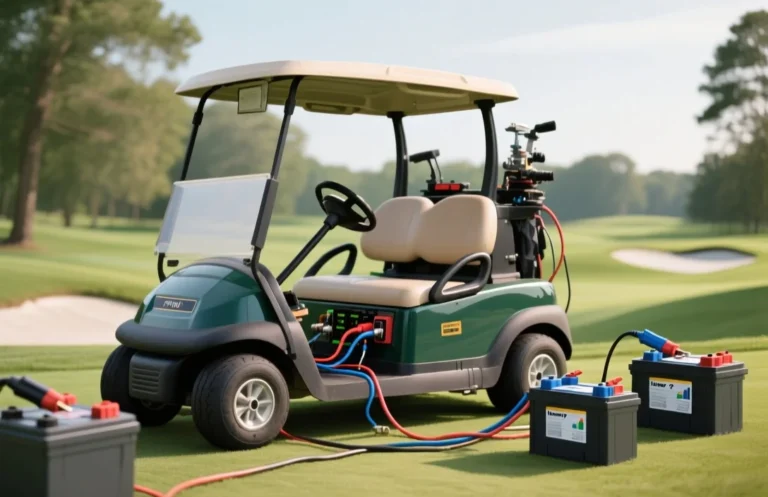
Golf cart batteries are usually wired in series to reach the cart’s system voltage, commonly 36V or 48V; match battery voltage and chemistry, connect positive to negative sequentially, secure terminals, and use a charger rated for the same voltage, with power disconnected before you start.
Required Voltage and Banks
Match the cart’s required pack voltage to the sum of the batteries in series, because the controller and charger must see the same nominal voltage. Most carts are either 36 volt or 48 volt systems, so count battery voltages and confirm with the cart’s rating plate before wiring.
Read every label you can find: the cart placard, under-seat sticker, controller label, and each battery top or side. Look for V for nominal voltage, Ah for capacity, and chemistry type (flooded lead acid, AGM, gel, or lithium). Also note manufacture dates and cell serials; mismatched ages or chemistries create imbalance and shorten life.
For example, common pack builds use multiple lower-voltage batteries in series to reach the cart voltage, while parallel groups only increase capacity. Verify which configuration the manufacturer expects before changing any connections.
| Battery unit | Typical count in series | Resulting pack voltage |
|---|---|---|
| 6 volt | 6 | 36 V |
| 8 volt | 6 | 48 V |
| 12 volt | 4 | 48 V |
The controller and motor are rated for a nominal pack voltage; wiring more or fewer series batteries will change motor speed and may damage the controller. The charger must match the pack voltage too, and its charge profile should match the battery chemistry printed on the battery label.
Series vs Parallel Wiring
Series wiring increases pack voltage by adding battery voltages together while leaving amp-hour capacity the same, and parallel wiring increases available amp-hours by adding capacities while keeping voltage the same. Most golf carts use series strings because the motor and controller require higher system voltage, which series wiring provides without huge increases in continuous current.
Series wiring links the positive terminal of one battery to the negative terminal of the next, so voltages add. If one battery in a series string is weak, the whole string’s performance falls and charging becomes uneven, so batteries must be matched closely.
For example, using three 12 volt batteries in series creates a 36 volt string with the same Ah rating as each battery. That higher voltage lets the controller draw less current for the same power, which reduces conductor size and heat but increases dependency on every battery in the chain.
Parallel wiring ties positives together and negatives together, so the pack keeps the base voltage and the amp-hour capacity increases. Parallel strings can extend runtime and add redundancy, but they raise the pack’s available current, which can overload undersized cables and fuses if not designed for it.
| Effect | Series | Parallel |
|---|---|---|
| Voltage | Adds (Vtotal = V1 + V2 …) | Stays the same as one battery |
| Capacity (Ah) | Same as one battery | Adds (Ahtotal = Ah1 + Ah2 …) |
| Typical golf cart use | Common – achieves controller voltage | Less common – used to increase runtime or pack capacity |
| Trade-off | Requires matched batteries; single weak cell limits pack | Needs heavier cabling and careful fusing |
Safety rule: Never mix batteries of different voltages, Ah ratings, chemistries, or markedly different ages in the same pack; mismatches increase the risk of overheating, premature failure, and unsafe charging behavior.
Battery Selection Checklist
Match the cart’s nominal pack voltage and use batteries with the same Ah rating and the same chemistry across the entire pack, because mismatched cells cause imbalance, poor charge acceptance, and safety risks. Verify the charger and any onboard battery management system are compatible with the replacement chemistry before you buy.
Chemistry choice affects how you hook batteries up and maintain them. Flooded lead acid needs venting, water top-ups, and an equalization-capable charger; AGM is sealed, lower maintenance, and usually works with the same charger profile as flooded but check charge voltages; lithium (LiFePO4 or similar) is lighter with higher usable capacity, but it requires a BMS and a charger set for lithium charging and cannot be mixed with lead acid cells.
| Chemistry | Pros | Cons | Installer notes | Cycle life (qualitative) |
|---|---|---|---|---|
| Flooded lead acid | Lowest upfront cost, tolerant to deep discharge | Requires watering, venting, heavier | Needs vented box, equalization-capable charger | Lower |
| AGM | Sealed, less maintenance, fits many retrofits | Cost higher than flooded, heavier than lithium | Usually drops in for flooded with charger check | Moderate |
| Lithium (LiFePO4) | Lightweight, more usable capacity, faster recharge | Higher upfront cost, requires BMS and proper charger | Replace whole pack, ensure BMS integration and charger profile | Higher |
Warning: Do not install a lithium battery into a lead-acid pack or charge lithium with a lead-acid charger unless the charger and BMS explicitly support that chemistry; mixing systems causes fire and permanent damage.
Check date codes and ask the seller for production and storage details, because long storage at partial charge reduces usable life. Read the warranty fine print for capacity thresholds and prorated vs full-replacement terms before committing to a purchase.
Tools and Parts Needed
Hooking up golf cart batteries requires insulated hand tools, correctly sized battery cables and clean, corrosion-free terminals to prevent high-resistance connections, arcing, and acid exposure. Bring a torque wrench or proper nut drivers and a few safety consumables so you can make secure, long-lasting joints without stopping midway.
Before you buy parts, confirm the cart’s voltage, the number of batteries, and the terminal stud size from the cart manual or the battery labels, since cable gauge, lug size, and clamp type must match those specs. Bring a multimeter to verify voltage and state of charge on arrival, and plan cable lengths so you can route them without tight bends or chafing.
| Item | Amount / Specification | Notes |
|---|---|---|
| Insulated hand tools | Set of insulated wrenches, sockets, screwdrivers | Insulation reduces risk of accidental shorting against exposed posts |
| Protective gear | Rubber electrical gloves, leather overgloves, safety goggles | Always wear eye protection and gloves when handling batteries |
| Battery cables | Correct gauge and length (match cart amp draw and run length) | Use stranded, tinned or marine-grade copper; avoid undersized wire |
| Terminal lugs & clamps | Crimp or solder lugs sized to post stud diameter | Match lug hole to battery post, replace corroded clamps |
| Crimping tool | Hydraulic or heavy-duty ratchet crimper for large lugs | Poor crimping is a common failure point |
| Torque wrench / nut drivers | Appropriate sizes for battery posts and terminal nuts | Check manual for torque specs, tighten to spec to avoid damage |
| Cleaner & neutralizer | Battery terminal brush, baking soda, water, spray bottle | Baking soda neutralizes acid, brush removes corrosion |
| Dielectric grease & terminal protectors | Small tube of grease, felt washers or anti-corrosion caps | Apply to prevent future corrosion after connections are clean |
| Multimeter & hydrometer | 1 each | Multimeter for volts, hydrometer for flooded cell specific gravity if needed |
| Misc consumables | Heat shrink, cable ties, rags, distilled water (flooded cells) | Carry extra lugs and fuses; distilled water only for flooded batteries |
| Battery handling tools | Carrying strap or small battery jack | Prevents dropping batteries and spilling acid |
| Owner’s manual / wiring diagram | 1 copy (cart and batteries) | Essential for correct series/parallel layout and torque values |
Wiring Step-by-Step
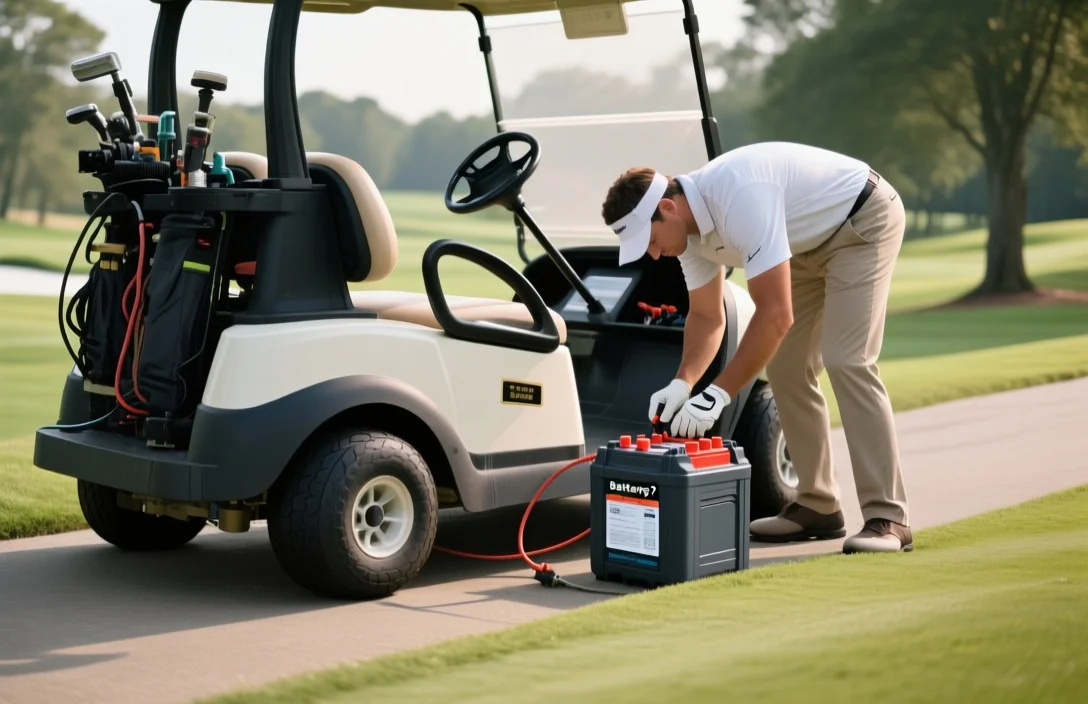
Disconnect batteries by removing the negative terminal first, then the positive, and when reconnecting attach the positive terminals first and the negative last. Follow a strict sequence, use rated cables and insulated tools, and stop immediately if you see swelling, leaking, or heavy corrosion.
Warning: If you detect excessive heat, sulfur smell, or persistent sparking during connection, stop immediately and isolate the pack. Always consult the cart or battery manual for specific torque and charging parameters when available.
Charger Compatibility and Hookup
Match the charger output voltage to the battery pack nominal voltage and pick a charger with a charging profile for the battery chemistry, flooded lead-acid, AGM, gel, or lithium. Use a multi-stage charger with an appropriate equalization or absorption stage for lead-acid packs, and use a charger that specifically supports lithium profiles when the cart has lithium batteries and a BMS.
Multi-stage chargers matter because they reduce gassing, limit heat, and restore capacity by moving through bulk, absorption, and float stages; equalization is a controlled overcharge used only on flooded lead-acid packs to balance cell voltages. AGM and gel batteries usually do better with limited equalization voltage and only if the manufacturer permits it, while lithium batteries should never be equalized in the lead-acid sense.
Safety warning: never mix battery chemistries in the same pack, do not use a charger with the wrong voltage, and do not charge swollen or leaking batteries. If the cart has a factory charge port, prefer that port because it often contains a fuse or control logic, but still verify the charger matches the pack specs before use.
Capacity and Runtime Estimates
Battery pack energy is Wh equals volts times amp-hours, and runtime is Wh divided by the steady load in watts. In practice you will get less than the simple math predicts because motor draw, terrain, speed, depth of discharge, and battery age reduce usable energy.
New batteries hold closer to their rated Ah and have lower internal resistance, so they deliver closer to the calculated runtime. Aged batteries lose capacity and show faster voltage sag, which reduces real-world runtime even if the label still lists the original Ah.
For example, a 48 V pack rated at 200 Ah gives 9,600 Wh on paper. If your average running power is 1,200 W and you design for 50 percent usable capacity, expected runtime is (9,600 × 0.5) ÷ 1,200, or about four hours; change the usable fraction and load to match your priorities.
Safety, Storage and Maintenance
When hooking up golf cart batteries you must control ventilation, temperature, and electrolyte levels before you make electrical connections. Flooded lead acid batteries can emit hydrogen gas during charging, heat and swelling are signs of failure, and cells that fail voltage or specific gravity checks should be removed and replaced.
Always provide cross-ventilation around the battery bay and charge in an open or vented area, not inside enclosed sheds without airflow. Avoid sparks and open flames near batteries, and keep chargers and wiring in good condition to prevent heat buildup.
Watch for heat and physical changes. If a battery is unusually hot after a short run or charging, or if the case bulges or vents are deformed, stop charging and isolate that battery.
| Symptom | Likely cause | Immediate action |
|---|---|---|
| Hot case during/after charge | Charging fault or internal short | Disconnect charger, allow cool, test individual battery |
| Swollen or bulging case | Overheating, plate damage | Do not reuse, replace battery |
| Acid leaks or cracked case | Physical damage | Remove safely, neutralize spill, replace battery |
| Low voltage after full charge | Bad cell or sulfation | Perform load and specific gravity tests, consider replacement |
For storage, keep batteries on a float or maintenance charger where practical, or at a moderate state-of-charge and check them monthly. If you store for a season, recharge before storage and again every 4 to 12 weeks depending on temperature and self-discharge; cold slows self-discharge but does not eliminate it.
Replace batteries when one or more cells fail to reach expected voltage or specific gravity after a proper charge, when cases are cracked or swollen, or when repeated recharging fails to restore capacity. Persistent underperformance under load is a clear replacement trigger.
If a battery is leaking, swollen, or still low after a correct charge and equalization, stop using it and replace it; continued service risks fire, hydrogen gas, and acid damage.
Quick Summary
Hook golf cart batteries in the correct series or parallel arrangement, matching voltage and chemistry, and follow safety and manufacturer charging rules.
Frequently Asked Questions
How do I hook up golf cart batteries in series or parallel for a 48V system?
You can wire batteries in series to increase voltage and in parallel to increase capacity, for a 48V cart you typically use eight 6V batteries in series or four 12V batteries in series.
How do I hook up golf cart batteries to the charger, and what charger specs do I need?
You can connect the charger to the battery pack only after confirming the pack voltage, use a charger that matches the pack voltage, for example a 48V charger for a 48V pack, and follow the manufacturer recommended charge current, commonly around 10% of the battery Ah rating.
How hot will golf cart batteries get when I hook them up, and when is heat a problem?
You can expect batteries to feel warm during charging or heavy discharge, but if surface temperature exceeds 50 degrees C (122 degrees F) or you see swelling or a strong odor, stop and inspect because that indicates overheating or failure.
How long will my golf cart run after I hook up the batteries?
You can estimate runtime by dividing battery capacity in amp-hours by the average current draw, for example 100 Ah ÷ 20 A = 5 hours, and remember real-world factors like terrain and accessory loads will reduce that time.
How do I avoid common buying and hookup mistakes and know when to replace golf cart batteries?
You can avoid mistakes by matching battery voltage, chemistry and age, never mixing old and new batteries, and replace batteries when measured capacity drops below 50% of rated Ah or when runtime and performance fall noticeably.