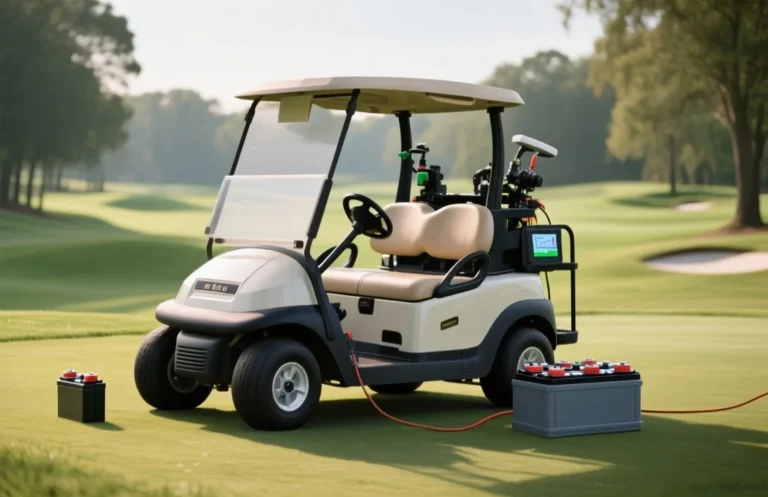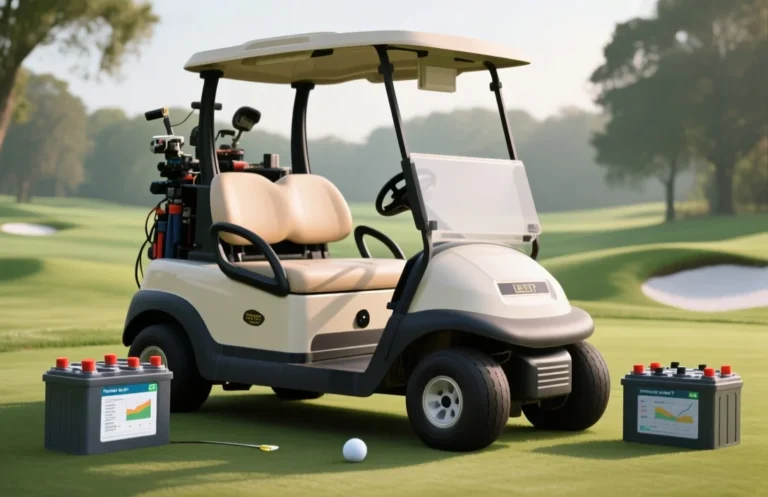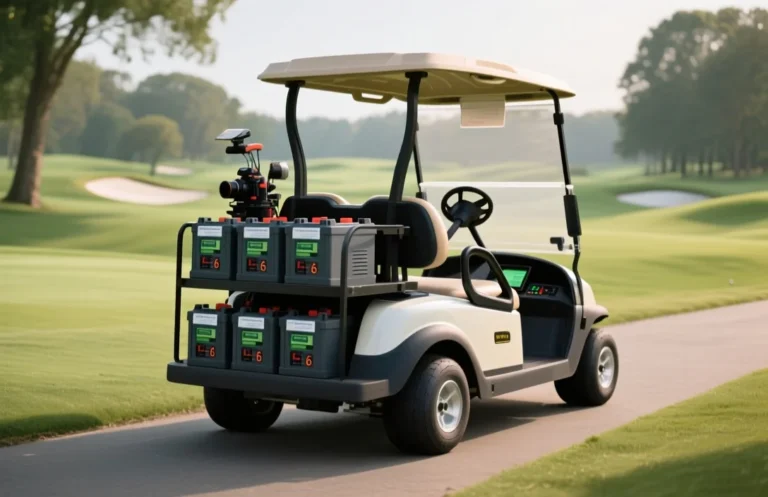
How do you test golf cart batteries?
One weak 6V battery can drop a 48V golf cart pack by 6V, instantly cutting range and performance. The spec that matters most is pack voltage and chemistry, so check the battery label and charger setting first. A common mistake is testing immediately after charging instead of after a proper rest period.
How do you test golf cart batteries? Measure resting pack voltage after a 4 to 6 hour charge rest, check each flooded cell’s specific gravity with a hydrometer (full charge about 1.265), then run a 10 to 15 second load or conductance test and replace any cell far below spec.
When to Test Golf Cart Batteries
Test golf cart batteries whenever you see clear performance loss, after any deep discharge or long storage period, and before buying or selling a used cart. For fleets, test on a regular schedule; for seasonal or recreational users, test at the start and end of the season and any time the cart behaves unusually.
Common failure symptoms that require testing include slow acceleration, reduced driving range, batteries that take much longer to reach full charge, repeated charger cutouts, and dashboard battery warnings. Visible signs that demand immediate attention are uneven cell caps, corrosion at terminals, and any swelling or strong chemical smells.
Routine testing cadence depends on use. For commercial fleets or heavy duty use, test monthly to quarterly depending on duty cycle and duty severity, because early cell weakness spreads quickly under load. For private owners who ride occasionally, test at the beginning and end of the driving season, and immediately after any unusually deep discharge.
| Trigger | When to Test | Why | Recommended Urgency |
|---|---|---|---|
| Performance loss or warning lights | Test immediately | Confirms whether cells are weak or charger/connector issue | High |
| Fleet use | Monthly or quarterly depending on duty | Find early deterioration before a failure in service | High |
| Seasonal storage | At storage and on return to service | Detect self-discharge and stratification after siting | Medium |
| Deep discharge or dead battery | Test before attempting normal charging | Determine reversible state versus permanent capacity loss | High |
| Pre-purchase or post-accident | Test before transaction or reuse | Verify advertised capacity and detect hidden damage | High |
For pre-purchase checks, always ask for the battery age, maintenance records, and a recent load or state-of-charge test from the seller. Follow with these quick checks before you buy:
Trade-offs: testing more often catches problems earlier but costs time and modest testing equipment or shop fees. Keep simple records of test dates and results so you can spot gradual capacity loss, and prioritize replacement when multiple cells show low readings rather than chasing charger issues. If you see swelling or active leakage, stop and seek professional help before any further testing.
Safety Before Testing Golf Cart Batteries
Before testing golf cart batteries, ensure you are protected and the environment is safe. Proper personal protective equipment (PPE), such as goggles and gloves, is essential to shield against acid spills and electrical hazards. Adequate ventilation is also necessary to disperse hydrogen gas, which can accumulate and be explosive.
By following these safety measures, you can significantly reduce the risks associated with testing golf cart batteries. Always prioritize safety to ensure a smooth and hazard-free testing process.
Tools and Meters for Golf Cart Batteries
Testing golf cart batteries requires specific tools that ensure accurate readings and assessments of battery health. Essential tools include a digital multimeter for voltage measurements, a hydrometer or refractometer for checking flooded cell electrolyte levels, and a load tester or conductance tester for assessing overall battery performance. Additional tools like thermal imaging devices and compatible chargers also play critical roles in the testing process.
| Item | Amount/Specification | Notes |
|---|---|---|
| Digital Multimeter | 0-20V DC range | Use for measuring voltage and checking for electrical shorts or faults. |
| Hydrometer/Refractometer | Specific gravity measurement | Essential for determining electrolyte density in flooded batteries. |
| Load Tester | Battery rating (e.g., 100A for 10 seconds) | Tests battery capacity under load conditions. |
| Conductance Tester | Varies by model | Measures battery health based on conductance; quicker than load testers. |
| Infrared Thermometer | Non-contact measurement | Detects hot spots on batteries that may indicate issues. |
| Compatible Charger | Correct voltage and amperage for the battery type | Ensures safe and effective charging during testing. |
Voltage Test for Golf Cart Batteries
Testing the voltage of golf cart batteries involves measuring the resting voltage after a full charge, assessing each battery in a series, and comparing the voltages to identify any imbalances. This process helps determine the health of the batteries and ensures they operate effectively.
Load Test for Golf Cart Batteries
A timed resistive load test, where you draw a known current and measure the battery voltage under load, gives the most direct indication of whether a golf cart battery can deliver current. A conductance or battery analyzer gives a fast, noninvasive number you can trend and use to match batteries, but it does not replace a proper resistive load test when a definitive pass/fail decision is needed.
Safety first: wear eye protection and insulated gloves, remove jewelry, work in a ventilated area, and keep tools from shorting terminals. Charge the battery fully and let it sit for several hours so surface charge clears before either test, and follow the manufacturer torque and terminal specifications.
Conductance testing uses a tiny excitation and measures the battery’s ability to conduct current, producing a number tied to remaining capacity and internal condition. It is fast, safe, and good for regular condition monitoring and for matching batteries, but it can give false high results after a recent charge or false low with heavy sulfation, so use it as part of a program rather than the only test.
For example, manufacturers provide under-load voltage thresholds and conductance baselines you must follow, but a practical rule is that a battery dropping well below expected under-load voltage or showing a conductance number far below the pack average indicates replacement. Replace a battery when under-load voltage falls below the maker’s limit, when conductance is substantially lower than matched batteries, or when repeated tests give inconsistent results.
Repeat tests when readings are borderline, after a full charge and rest, or if temperature changes. Always isolate and retest individual batteries in a string before deciding to replace multiple units, because one bad battery can make an otherwise good pack fail.
State-of-Charge & Capacity Checks
Specific-gravity measurement for flooded cells and a controlled amp-hour discharge are the two practical ways to confirm a golf cart battery’s state-of-charge and its real remaining capacity. A hydrometer gives per-cell SOC snapshots on flooded batteries, while a full amp-hour discharge test tells you how many amp-hours the pack actually delivers under load.
Use the hydrometer when you need a quick assessment and the amp-hour discharge when you need a definitive capacity number for estimating runtime or deciding on replacement. The hydrometer is fast but limited to flooded cells and affected by temperature, while the amp-hour test is most accurate but requires time, a calibrated load, and safe procedures.
Safety note: Always wear eye protection and gloves, work outdoors or in a ventilated area when opening flooded batteries, and avoid sparks around charging or discharging equipment. If you see swelling, severe corrosion, or extreme imbalance, stop testing and consult a qualified battery technician for repair or replacement options.
Charger Compatibility and Recovery
To effectively test golf cart batteries, it is essential to ensure that the charger used matches the battery’s chemistry and condition. This involves setting the correct voltage and current, performing equalization charging for flooded batteries, and utilizing recovery charges for deeply discharged batteries to restore their performance.
When using a charger, always verify the following:
Equalization and Recovery Charge Procedures
Equalization charging is crucial for flooded lead-acid batteries, helping to balance the charge across all cells. This process should be performed periodically and under controlled conditions:
For deeply discharged batteries, a recovery charge may be necessary:
Diagnosing Charger versus Battery Problems
If issues arise during charging, differentiate between charger and battery faults. Here are some diagnostic steps:
Remember, a charger may appear to be faulty when, in fact, the battery is the source of the problem.
Post-Charge Verification Steps
After charging, it is essential to verify the battery’s state:
By following these guidelines, you can ensure that your golf cart batteries are tested effectively and safely, optimizing their performance and longevity.
Quick Summary
To test golf cart batteries, check voltage, specific gravity, conductance or load, and inspect connections and charging behavior to confirm condition.
Frequently Asked Questions
How do you test golf cart batteries with a multimeter?
You can take a resting voltage reading after the batteries have been charged and sat for at least 30 minutes; a common 6V battery should read about 6.3V fully charged and a 12V about 12.6V, so compare the reading to the battery label.
How do you test golf cart batteries for overheating or thermal problems?
You can run a controlled charge or discharge and monitor surface temperature with an infrared thermometer, if the battery surface rises more than 20°F (11°C) above ambient or exceeds the manufacturer temperature spec, stop testing and inspect for failure.
How do you test golf cart batteries to estimate runtime?
You can calculate energy using Wh = voltage x Ah and then divide by your load, for example a 48V 200Ah pack equals 9600 Wh, so a 1200 W load would run about 8 hours at 100 percent usable, but for lead acid use about 50 percent depth of discharge for realistic runtime planning.
How do you test golf cart batteries safely to avoid acid, sparks, or shock?
You can wear safety glasses and acid-resistant gloves, disconnect the charger and any loads, and wait at least 30 minutes after charging before taking resting-voltage or load measurements to reduce the risk of venting or spiking.
How do you test golf cart batteries to know when to replace them and avoid common buying mistakes?
You can run a proper capacity or load test and plan to replace a battery when usable capacity falls under 50 percent of rated Ah, and when buying replacements verify the pack voltage, terminal type, chemistry (flooded vs AGM), and group size to avoid compatibility errors.