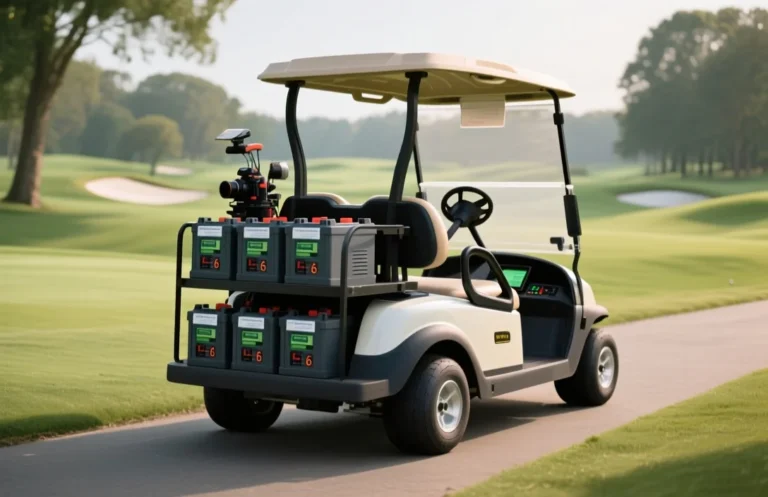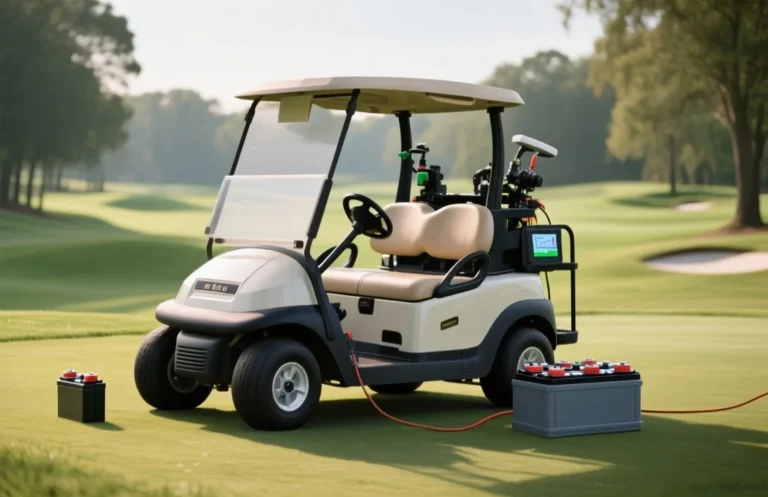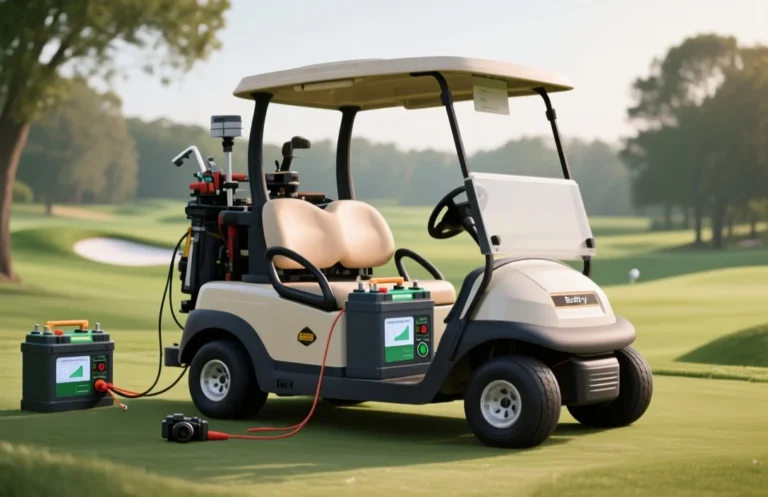
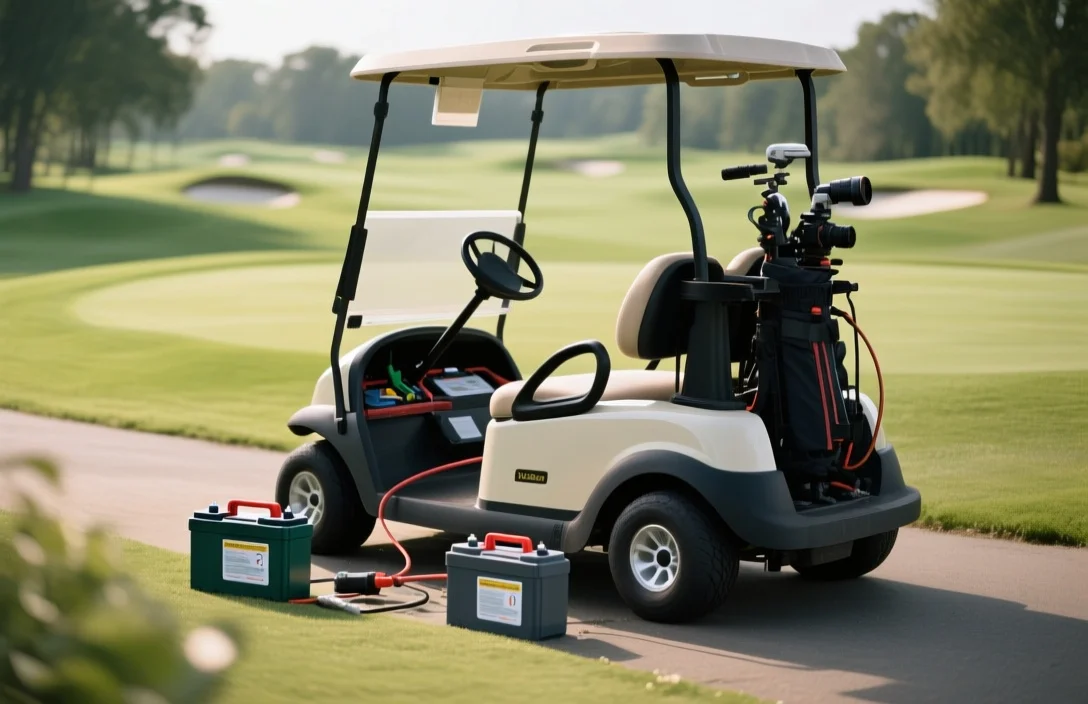
How to connect golf cart batteries?
Voltage, not amp-hours, is the single most important spec when wiring a golf cart battery pack. A common mistake is mixing voltages or wiring polarity wrong, which causes instant failure or sparks. First check the cart or controller voltage label and each battery’s stamped voltage and polarity marks before you touch a tool or cable.
How to connect golf cart batteries: wire batteries in series to reach the cart voltage (six 6V batteries = 36V, four 12V batteries = 48V), link positive-to-negative between cells, make the final system connection by attaching the positive terminal first and the negative last, then confirm total volts with a multimeter.
Preflight Tools & Safety
Before you touch a golf cart battery, stop, power down the cart and charger, remove metal jewelry, and put on PPE: acid-resistant gloves, splash goggles, and a face shield. Have the right insulated tools and a working DC multimeter ready, because loose terminals, stray metal, or poor ventilation can cause acid burns, sparks, or hydrogen ignition.
Emergency steps: for acid spills, flush the area with plenty of water after neutralizing with baking soda, remove contaminated clothing, and seek medical help for burns or inhalation. For thermal events or fire, evacuate, call emergency services, and use a Class BC dry chemical or CO2 extinguisher if safe; do not attempt to handle a thermal runaway battery yourself.
Wiring Diagrams & Configs
Six 6V batteries in series make a 36V pack; three 12V batteries in series also make 36V. Four 12V in series make 48V, and eight 6V in series also make 48V. Voltage adds in series, amp-hours stay the same; in parallel voltage stays the same, amp-hours add.
Series vs parallel math, plainly: series voltage = V1 + V2 + … , series Ah = Ah of one battery. Parallel voltage = Vbat, parallel Ah = Ah1 + Ah2 + ….
For example, six 6V @200Ah in series = 36V, 200Ah, which equals 36V 200Ah = 7200 Wh. Three 12V @100Ah in series = 36V, 100Ah = 3600 Wh.
| Config | Batteries | Total Voltage | Example Ah | Example Wh |
|---|---|---|---|---|
| 36V (6V) | 6 × 6V in series | 36V | 200Ah | 7200 Wh |
| 36V (12V) | 3 × 12V in series | 36V | 100Ah | 3600 Wh |
| 48V (12V) | 4 × 12V in series | 48V | 100Ah | 4800 Wh |
| 48V (6V) | 8 × 6V in series | 48V | 200Ah | 9600 Wh |
For example, a Club Car 36V replacement often uses six 6V batteries wired series, connecting the controller to the string ends.
For instance, wire battery 1 negative to cart negative, battery 6 positive to cart positive, and interlink 1+ to 2-, 2+ to 3-, etc.
For example, an EZGO converted to 48V will use four 12V in series or eight 6V in series; follow the same series rules and label the pack ends. With lithium or BMS-equipped batteries, ensure the BMS charge/discharge leads and CAN/communications are tied into the cart per the battery vendor instructions.
Connection Steps & Cable Specs
Connect the pack so the positive connections are made first and the negative (ground) is connected last, and when removing, take the negative off first and the positive last. Always inspect for cracked cases, corroded terminals, and matching voltage/capacity before you touch tools.
Typical cable recommendations by continuous current and run length (verify controller stall specs)
| Continuous Current (A) | Recommended AWG (<=3 ft) | Recommended AWG (<=6 ft) | Recommended AWG (<=12 ft) |
|---|---|---|---|
| 100 A | 4 AWG | 2 AWG | 1 AWG |
| 150 A | 2 AWG | 1/0 AWG | 2/0 AWG |
| 300 A | 2/0 AWG | 3/0 AWG | 4/0 AWG |
| 500 A | 3/0 or parallel 2/0 | 4/0 AWG | parallel 4/0 |
Lugs and crimping: Use copper, tin-plated lugs sized to the AWG; choose barrel lugs that match stud diameter and cable outer diameter. Use a hydraulic or ratcheting crimper rated for your largest lug, with a die set covering the AWG sizes you buy, and perform a pull test on every crimp.
Terminal torque guide: Small post nuts (5/16 inch) 4 to 8 lb-ft (5 to 11 Nm), 3/8 inch studs 10 to 15 lb-ft (13 to 20 Nm), large bus studs 20 to 40 lb-ft (27 to 54 Nm). Use a calibrated torque wrench, snug then torque in increments, and avoid over-tightening lead posts to prevent cracking.
Download wiring checklist (PDF) with step-by-step photos and an annotated video pointer included in the PDF. For critical values, always verify the controller and battery manufacturer documentation before finalizing cable sizes or fuse ratings.
Charger, Controller & BMS
Connect the charger to the battery pack positive and negative through the pack protection, not around it; the main fuse or breaker must sit on the battery positive feed before the contactor and controller. The motor controller battery terminals should be on the fused side of the contactor, and a pre-charge resistor or pre-charge circuit is required to limit capacitor inrush when closing the contactor.
Order of protection on the positive conductor is important: battery positive, main fuse/breaker, contactor/solenoid, then branch to controller and charger input. The charger positive should land at the pack positive or the charger/C-terminal on the BMS if the BMS requires it; charger negative must be on the pack negative or BMS negative as specified.
| Component | Where to connect | Notes |
|---|---|---|
| Main fuse/breaker | Battery positive, first device | Protects pack against downstream short circuits |
| Contactor/solenoid | After main fuse on positive | Use pre-charge circuit to limit inrush to controller |
| Motor controller | Fused positive and pack negative | Keep cables short and secure; check controller manual for pre-charge needs |
| Charger | To BMS charge terminals or pack terminals per manual | Set charger profile to match chemistry; avoid bypassing BMS |
Critical: If the BMS opens its charge or discharge MOSFETs the pack may show cell voltages on a meter but supply no current to the controller or charger; treat a dead pack as a BMS trip and troubleshoot per the BMS manual before applying high current.
Test, Troubleshoot & Maintenance
To ensure proper connection and function of golf cart batteries, conduct routine voltage tests, inspect connections, and follow a maintenance schedule. Regular testing with a multimeter can identify weak cells, and a checklist of common mistakes can prevent issues during setup.
Always connect the positive terminal first and disconnect the negative terminal last to avoid sparks. When charging, connect the charger to the battery pack after ensuring all connections are secure, and avoid charging in confined spaces to mitigate hydrogen gas risks. Regular inspection and maintenance can prolong battery life and ensure optimal performance.
Quick Summary
Connecting golf cart batteries requires careful attention to voltage, polarity, and safety to ensure proper function.
Frequently Asked Questions
How do I wire or connect golf cart batteries in series or parallel to get the right voltage?
You can wire batteries in series to add voltage or in parallel to add capacity; for example, six 6V batteries in series make 36V, while two 12V batteries in parallel keep voltage the same and double Ah.
How do I ensure replacement batteries are compatible when I connect golf cart batteries?
You can verify compatibility by matching the battery voltage, chemistry, and Ah rating exactly, and using batteries from the same manufacturer or batch when possible; match the voltage and Ah rating on the label exactly.
Can golf cart batteries overheat when I connect them, and what temperature is unsafe?
You can monitor temperature during charging and use; avoid sustained operation or charging above 50°C (122°F), and stop charging if you see rapid heating, bulging, or leaking.
How do I estimate runtime after I connect golf cart batteries to my cart?
You can estimate runtime by converting pack voltage and Ah to watt hours, for example a 36V 200Ah pack is 7200 Wh and, if you use about 50% of that for lead-acid, gives roughly 3600 Wh usable, then divide by motor watts to get hours.
What common mistakes should I avoid when I buy and connect golf cart batteries?
You can avoid problems by not mixing old and new batteries, checking polarity closely, and using the correct cable and connections; do not mix batteries with differing Ah ratings by more than about 10% and always follow your cart manual for wiring and cable size.