
Cost Difference Between 8 Volt And 12 Volt Golf Cart Batteries
If you are replacing batteries on a 48V golf cart, the first question is not which brand to buy. It is whether to build your pack with 8V or 12V batteries. The two paths reach the same total voltage through different unit counts: six 8V batteries or four 12V batteries. That unit count difference drives a real gap in upfront price, ongoing costs, and sourcing ease. This guide breaks down exactly what you will pay and where the money goes.
Cost Difference Between 8 Volt and 12 Volt Golf Cart Batteries
For a standard 48V golf cart, a complete 8V lead-acid pack (six batteries) typically runs $900 to $1,350 before installation. A complete 12V lead-acid pack (four batteries) runs $800 to $1,200 for the same system voltage. The 8V route costs more upfront for two reasons: you buy more individual units, and 8V batteries carry a higher price per unit because they are less commonly manufactured.
Quick Price Comparison: 48V Golf Cart Pack (Lead-Acid, 2025)
| Configuration | Units Needed | Price Per Unit | Total Pack Cost |
|---|---|---|---|
| 8V (e.g. Trojan T-875) | 6 batteries | $150 to $225 | $900 to $1,350 |
| 12V (e.g. Trojan T-1275) | 4 batteries | $200 to $300 | $800 to $1,200 |
| Budget (Crown / US Battery 8V) | 6 batteries | $130 to $170 | $780 to $1,020 |
Prices reflect flooded lead-acid batteries. Add $100 to $400 for professional installation depending on your region.
Why 8V Batteries Cost More Per Unit

The 8V format sits in a smaller market than 12V. Fewer manufacturers produce it, fewer retailers stock it, and lead times are less predictable. That supply constraint pushes the price per amp-hour higher even when the underlying chemistry is identical. A Trojan T-875 8V at 170Ah runs $170 to $220 per unit. A Trojan T-1275 12V at 150Ah runs $230 to $300 per unit. At first glance the 12V unit looks more expensive, but you only need four of them versus six 8V units, so the pack total lands lower for most buyers.
Budget brands like Crown and US Battery close the per-unit gap somewhat. Crown 8V batteries typically land at $130 to $170 each, bringing a six-pack to $780 to $1,020. That makes the budget 8V route competitive with mid-range 12V packs. The trade-off is usually a shorter rated cycle life and a narrower dealer network for warranty service.
Understanding the 8V Battery Pack
Six 8V batteries wired in series give you 48V. The most common configuration for EZGO and older Club Car models. The Trojan T-875, the most widely used 8V battery, is rated at 170Ah and weighs around 63 lbs per unit. Six of them add roughly 378 lbs to your cart before you even turn a wheel.
Total energy for a six-pack of 170Ah 8V batteries: 6 x 8V x 170Ah = 8,160 Wh, or about 8.2 kWh. That is the number to keep in mind when you compare it against a 12V pack below.
The 8V format also demands a charger calibrated for that string. Dedicated 8V string chargers are harder to find and can carry a premium of $30 to $80 over a comparable 12V charger. If you are building a new system from scratch, that charger cost belongs in your total budget.
8V Pack Total Cost Breakdown
| Cost Item | Typical Range |
|---|---|
| 6 x 8V batteries (budget brand) | $780 to $1,020 |
| 6 x 8V batteries (Trojan / premium) | $1,020 to $1,350 |
| Compatible 48V charger | $80 to $250 |
| Professional installation | $100 to $400 |
| Estimated full replacement total | $960 to $2,000 |
Understanding the 12V Battery Pack
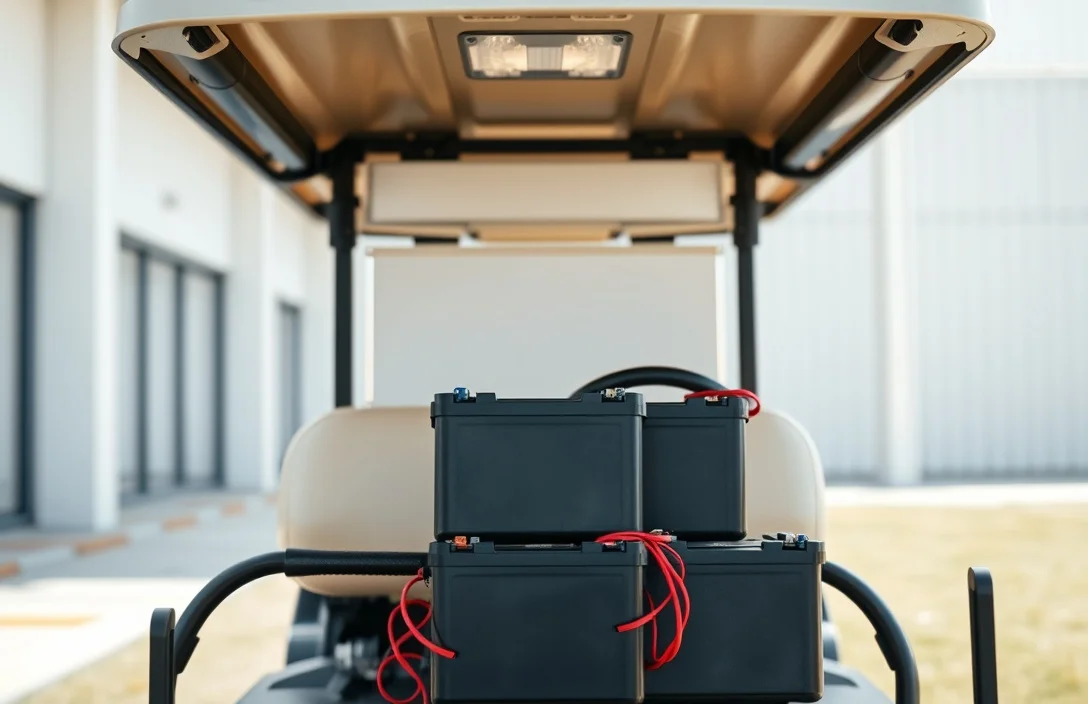
Four 12V batteries in series produce 48V. The 12V deep-cycle format is far more widely manufactured, which means more competing suppliers, easier sourcing, and more predictable prices. The Trojan T-1275 12V at 150Ah is one of the most common options and retails at $220 to $268 per unit depending on the dealer, putting a four-pack at roughly $880 to $1,072 for premium Trojan units.
Total energy for a four-pack of 150Ah 12V batteries: 4 x 12V x 150Ah = 7,200 Wh, or about 7.2 kWh. Slightly less stored energy than the 8V six-pack scenario above, which is why comparing watt-hours rather than voltage or unit count is the honest way to evaluate these packs head to head.
12V Pack Total Cost Breakdown
| Cost Item | Typical Range |
|---|---|
| 4 x 12V batteries (budget brand) | $600 to $800 |
| 4 x 12V batteries (Trojan T-1275) | $880 to $1,200 |
| Compatible 48V charger | $60 to $200 |
| Professional installation | $100 to $400 |
| Estimated full replacement total | $760 to $1,800 |
8V vs 12V: Direct Price Comparison by Brand
Here is how the real-world numbers stack up across the major brands you will encounter at dealers and online retailers in 2025:
| Brand / Model | Voltage | Capacity | Price Per Unit | 48V Pack Total |
|---|---|---|---|---|
| Trojan T-875 | 8V | 170Ah | $170 to $220 | $1,020 to $1,320 |
| Trojan T-1275 | 12V | 150Ah | $230 to $300 | $920 to $1,200 |
| Crown CR-150 | 8V | 150Ah | $130 to $170 | $780 to $1,020 |
| US Battery US-8VGC | 8V | 170Ah | $140 to $180 | $840 to $1,080 |
| Generic / budget 12V | 12V | 150Ah | $150 to $200 | $600 to $800 |
Pack totals based on 6 units for 8V, 4 units for 12V, both reaching 48V system voltage.
The Hidden Cost Factor: Watt-Hours vs Unit Count
Never compare batteries by unit price alone. A 12V battery at $260 looks more expensive than an 8V at $190. But when you calculate the total pack cost and total stored energy, the picture shifts. Here is what the math actually looks like:
Example: Trojan T-875 (8V) vs Trojan T-1275 (12V) for a 48V cart
8V path: 6 x $195 (mid-price) = $1,170 total | 6 x 8 x 170 = 8,160 Wh | Cost per kWh: $143
12V path: 4 x $265 (mid-price) = $1,060 total | 4 x 12 x 150 = 7,200 Wh | Cost per kWh: $147
At mid-range Trojan prices, the two options are nearly equal in cost per kWh. The 8V pack stores more energy total but costs $110 more upfront.
The key takeaway: always convert to watt-hours (voltage x amp-hours) before comparing packs. A 6-battery 8V setup actually stores more total energy than a 4-battery 12V setup when both packs use similar Ah ratings. If your primary concern is maximum runtime, the 8V pack wins on energy density at the system level. If your concern is lowest upfront cash outlay, the 12V pack wins on unit count.
Charger Costs: 8V vs 12V Systems

The charger is not an afterthought. A mismatched charger will shorten your pack life, and replacing batteries early erases any savings you made at purchase. Here is what each voltage path typically adds in charger costs:
8V systems run on a 48V charger matched to flooded lead-acid chemistry. Dedicated chargers for 8V string arrays are less common in big-box retail and usually run $80 to $250. If you are already on an 8V system and just replacing batteries, your existing charger likely still works and does not add to the cost. If you are buying new hardware from scratch, budget for the charger alongside the batteries.
12V systems benefit from wider charger availability. A quality 48V smart charger with automatic shutoff and temperature compensation runs $60 to $200 for most standard golf cart applications. More competing products mean better pricing and easier local sourcing when a charger fails. For outdoor or fleet use, look for splash resistance and an IP65 or better rating.
The practical rule: never share a charger between an 8V and 12V string, and never use a charger rated for a different total voltage than your pack. Overcharging a lead-acid cell accelerates gassing, warps plates, and shortens life by months per incident.
Lifespan and Long-Term Cost of Ownership
Upfront price is only part of the cost story. How long your pack lasts determines your annual cost per mile. Here is how the two formats compare on longevity:
| Factor | 8V Pack | 12V Pack |
|---|---|---|
| Typical lifespan (flooded lead-acid) | 4 to 6 years | 3 to 5 years |
| Replacement frequency | Less often | More often |
| Number of connection points | More (6 units) | Fewer (4 units) |
| Water maintenance (flooded type) | 6 batteries to service | 4 batteries to service |
| Parts and replacement availability | Limited suppliers | Widely available |
The 8V format typically outlasts 12V lead-acid packs by one to two years because each cell operates at a lower per-cell stress level. If you replace the full set every five years on average, the 8V route may cost less over a ten-year ownership window even though each replacement is more expensive. Running the numbers for your specific usage cycle is worth 15 minutes before you commit to a brand and format.
Should You Switch from 8V to 12V? (And What It Costs)
If your current 8V batteries are aging and you are finding it harder to source replacements locally, converting to a 12V configuration is a real option. It is not simply a drop-in swap, though. Here is what the transition involves and what it costs:
You will need a new charger rated for your 12V string, and depending on your cart model, potentially updated battery cables and hold-down hardware. A basic conversion kit typically costs $150 to $400 for the wiring harness, fuses, and mounting adapters. Professional installation adds $100 to $300. Check your speed controller specs before committing: some older controllers are calibrated for a specific voltage topology, and switching configurations may require a controller adjustment or replacement.
When does conversion make financial sense? When local 8V battery prices exceed the 12V equivalent by more than $150 for the full set, or when lead times on 8V replacements regularly run more than two weeks. Otherwise, staying on your existing format and buying from a reputable supplier is usually cheaper than absorbing the conversion cost.
Battery Monitoring and BMS Costs
For standard flooded lead-acid packs, you do not need a dedicated BMS. Regular voltage checks with a $20 multimeter and monthly water top-ups cover most maintenance needs. The BMS cost becomes relevant when you are looking at lithium upgrades.
For a 48V LiFePO4 pack, a BMS typically adds $50 to $250 to the total system cost depending on cell count and feature set. Basic BMS modules handle overcharge, over-discharge, and thermal protection and run $50 to $100. More capable units with active balancing and communication interfaces run $120 to $250. An 8V-based lithium setup requires monitoring more cells (higher cell count in the string), which can push BMS costs $30 to $60 higher than a comparable 12V lithium string for the same total voltage.
Lithium Option: How It Changes the 8V vs 12V Price Math
If you are willing to move past lead-acid entirely, a LiFePO4 conversion changes the comparison significantly. A complete 48V lithium pack runs $1,600 to $4,500 depending on brand and capacity, with mainstream options from brands like ECO Battery, RoyPow, and Relion in the $2,200 to $3,400 range for 100 to 105Ah packs.
The lithium upgrade eliminates the 8V vs 12V decision entirely because most lithium golf cart packs are sold as a single integrated 48V unit. You do not choose how many cells to string together. You choose a pack that matches your cart’s voltage and buy one unit. The tradeoff is the higher purchase price and the need for a lithium-compatible charger. Over a ten-year window, however, a lithium pack that lasts 8 to 10 years without maintenance often beats three replacements of lead-acid packs on total lifetime cost.
Lead-Acid vs Lithium 10-Year Cost Estimate (48V, Standard Use)
8V lead-acid: Two replacements x $1,200 avg = $2,400 + $200 maintenance = ~$2,600 total
12V lead-acid: Two to three replacements x $1,000 avg = $2,000 to $3,000 + $200 maintenance = ~$2,200 to $3,200 total
48V LiFePO4: One pack at $2,800 avg + $350 charger + $0 maintenance = ~$3,150 total, one replacement cycle only
Estimates vary significantly by usage intensity, climate, and brand. These are illustrative ranges, not guarantees.
What to Check Before You Buy
Before finalizing your battery purchase, run through these five checkpoints to avoid buying the wrong product at the wrong price:
1. Confirm your cart’s system voltage. Check under the seat or in the owner’s manual. Most modern golf carts are 48V, but older EZGO TXT models may be 36V. A 36V system uses six 6V batteries, not the 8V or 12V configurations discussed here.
2. Never mix voltages in the same string. Connecting four 8V and two 12V batteries is a safety hazard. Some cells will overcharge while others undercharge, accelerating gas production and risk of damage.
3. Replace the full set at once. Mixing old and new batteries of the same voltage still causes imbalance. Newer units compensate for weaker old ones, shortening the life of the entire string.
4. Verify charger compatibility. Your charger must be rated for the exact pack voltage and chemistry. Check the label on the charger before assuming it works with a new battery set.
5. Compare in watt-hours, not just unit price. Calculate total Wh for each option (voltage x Ah x number of batteries). This is the only honest way to compare energy storage value across different voltage formats.
Quick Summary: 8V vs 12V Golf Cart Battery Cost
For a 48V cart, the 12V path saves you $100 to $300 upfront in most scenarios because you buy fewer units even though each one costs more. The 8V path gives you slightly more total stored energy and potentially longer pack lifespan, which can offset the higher initial cost over time. Budget buyers who want the lowest possible replacement cost on a single swap will usually find the 12V option wins. Buyers who want maximum runtime, plan to hold the cart long-term, and service their batteries regularly will often get better value from the 8V configuration despite the higher sticker price.
Frequently Asked Questions
How much cheaper is a 12V golf cart battery pack than an 8V pack for a 48V system?
For most name-brand lead-acid batteries, the 12V four-pack runs $100 to $250 less than an equivalent 8V six-pack. Budget brands narrow that gap. At the premium Trojan level, a T-875 six-pack costs roughly $1,020 to $1,350 vs $920 to $1,200 for a T-1275 four-pack. The 8V pack also stores about 13% more total energy at those specs, so the cost-per-watt-hour gap is smaller than the sticker price difference suggests.
Is it cheaper to run 6 x 8V or 4 x 12V batteries long-term?
It depends on usage and maintenance. The 8V pack typically lasts one to two years longer than a 12V lead-acid pack under similar conditions, which means fewer replacement cycles over a ten-year period. If you replace batteries every four to five years, the 8V route may come out cheaper over a decade even though each replacement costs more per transaction. Run a simple lifecycle calculation: (average replacement cost) divided by (expected years of service) to compare your real annual battery cost for each format.
Can I replace 8V batteries with 12V to save money?
You can convert, but it is not a simple swap. You need to reduce battery count from six to four, update the charger, and check controller compatibility. The conversion kit, charger, and labor typically add $300 to $700 to the project, which may offset any savings on the batteries themselves. Conversion makes sense when 8V batteries are genuinely hard to source in your region or when local 8V prices are unusually high. Otherwise, sticking with your existing voltage and buying a reliable brand is usually the cheaper path.
What is the price difference between 8V and 12V Trojan golf cart batteries?
At current retail prices, a Trojan T-875 8V battery runs $170 to $220 per unit vs $230 to $300 per unit for a Trojan T-1275 12V. The 12V unit is more expensive individually, but you only need four of them for a 48V system vs six 8V units. At mid-range pricing, the 8V six-pack costs about $100 more than the 12V four-pack at the Trojan tier.
Are there safety concerns when mixing 8V and 12V batteries or using the wrong charger?
Yes, this is a serious risk. Never mix 8V and 12V batteries in the same series string and never use a charger rated for a different total pack voltage. Mismatched strings overcharge some cells while undercharging others, which increases hydrogen gas production, risks plate warping, and in worst cases causes thermal events. Always match every battery in your string to the same voltage, capacity, chemistry, brand, and age where possible.