
Wholesale Golf Cart Battery Prices
A wrong charger setting can cook a battery pack, even when the “wholesale price” looks great. Before you request quotes for 36V or 48V golf cart batteries, verify the exact battery type, voltage, and charger compatibility label. This page gives practical wholesale price ranges, MOQ and bulk discount tiers, typical lead times, warranty terms, and the spec checklist that stops costly mismatches.
Wholesale golf cart battery prices vary by voltage and chemistry: 6V lead-acid usually costs less per unit than lithium, while lithium packs cost more but often last longer. Wholesale quotes commonly change at MOQ breaks like 10 to 50 batteries or a full pack order, and shipping can add days for 36V and 48V builds. Confirm warranty coverage and charger acceptance before buying.
wholesale golf cart battery prices landscape

Wholesale pricing for golf cart batteries is usually quoted by pack voltage (6V or 8V series vs 36V, 48V systems) and by chemistry (flooded lead-acid, AGM, lithium).
In practice, the price spread is driven more by volume purchase terms and warranty structure than by list price, so procurement documents often look very different between suppliers.
Typical wholesale “bands” buyers see are these: flooded lead-acid is the lowest entry cost, AGM sits higher for vibration resistance and maintenance convenience, and lithium-iron-phosphate (LiFePO4) costs more up front but can reduce long-term replacement frequency if the pack is sized and charged correctly. Because wholesale catalogs vary by cell grade, brand, and whether pricing includes chargers or core fees, buyers should request a line-item quote that spells out capacity rating, cycle-life expectations, and warranty length per battery and per pack.
| Golf cart pack voltage (system) | Chemistry band commonly offered wholesale | What the quote should include | Procurement risk to verify |
|---|---|---|---|
| 36V (often built from 6V or 8V units) | Flooded lead-acid, AGM | Nominal voltage, amp-hour rating, dimensions, terminal type, warranty terms | Mixing generations or mismatched capacities in the same string |
| 48V (often built from 6V or 8V units) | Flooded lead-acid, AGM, LiFePO4 | Pack model number, BMS settings (for lithium), charge-voltage targets, warranty | Wrong charger profile (lead vs lithium), and missing BMS protection details |
| High-current use (fleet, slope routes) | AGM or LiFePO4 preferred | Cycle-life conditions, discharge rate assumptions, charging current limits | Overdriving chargers or using underspecified wiring and fusing |
Key drivers of wholesale pricing
Supplier pricing rises when you move from commodity lead-acid to branded or warrantied units with tighter manufacturing tolerances, and when the order includes testing, palletization, or staged shipments. Lithium packs cost more partly because buyers pay for the BMS, cell matching, and pack-level protections, and wholesalers will often price in charger compatibility support because wrong charging is a common failure mode.
In practice, the biggest swings come from (1) warranty duration and prorating style, (2) whether the quote includes a charger or requires you to source one separately, (3) whether the supplier offers “like-for-like” replacement fast enough to protect fleet uptime, and (4) shipping terms such as freight collect vs prepaid, hazmat handling for lead-acid, and whether lithium packs ship as regulated batteries under the carrier’s rules.
Total cost of ownership snapshot
Total cost of ownership (TCO) usually favors lithium when charging infrastructure is correct and batteries are not repeatedly cycled in extreme heat or overdischarged. Flooded lead-acid can be cheapest per battery today, but maintenance labor (water top-offs), corrosion management, and earlier replacements often erase the upfront advantage for operations with tight schedules.
For fleet buyers, TCO comparisons should include downtime risk: lead-acid systems that require equalization or electrolyte maintenance can disrupt operations, while lithium packs can protect against many misuse scenarios through BMS behavior, but they still need correct charger voltage and a compatible charge algorithm to avoid nuisance faults or premature wear.
Representative procurement brands and suppliers for this space vary by region (golf cart OEM channels, industrial battery distributors, and direct-from-manufacturer wholesale stores). For evaluation, buyers should ask each supplier to provide the same documentation line-by-line: battery model, rated capacity (amp-hour or equivalent), expected cycle-life under defined test conditions, charger compatibility notes, weight and dimensions for dock and install planning, and a clear warranty and replacement process.
Safety and compatibility reminder: Using the wrong charger profile (lead charger on a lithium pack, or an incompatible voltage target on lead) is a common way chargers and batteries fail quickly, especially in bulk fleet installations. Request written charge-voltage and current limits from the battery supplier, then verify the charger nameplate and settings match.
MOQ, bulk discounts, and order tiers
MOQs for golf cart battery orders are typically set by chemistry and packaging, often starting in the low tens to low hundreds of units. Bulk pricing usually follows a tiered structure where the first discount appears after meeting the MOQ, with deeper cuts at higher volumes. For new suppliers, propose a pilot or split-case order to verify performance before committing to a larger tier.
Lead times and shipping terms

Lead times by chemistry vary with stock levels and customization. Stocked flooded lead-acid golf cart batteries can ship in days, while custom lithium packs require several weeks. Expect 2-6 weeks for typical wholesale orders, with longer delays if certifications or container logistics are involved.
Shipping terms and carriers matter for total cost and risk transfer. Most wholesalers quote Incoterms such as FOB origin or DAP destination, which determine who pays freight and who bears transit risk. For international shipments, ocean freight in full container loads or LCL is common; domestic orders typically use LTL trucking or full truckload, with hazmat handling for certain chemistries.
Case studies and scenario planning help buyers align terms with fleet deployment.
For example, a regional dealer with ready stock can book FOB shipments and arrange local trucking to minimize handling, achieving fast door-to-door delivery. In contrast, a fleet order of LiFePO4 packs from overseas might use DAP terms and require schedule-based manufacturing, pushing total lead time to 6-12 weeks plus port-to-yard handling.
Container and pack delivery considerations influence risk and cost. Adequate packaging, palletization, and protective separators reduce damage during transit and simplify customs. Higher density container loads require careful planning of carton strength, moisture protection, and labeling to meet carrier and regulator requirements.
Typical lead time ranges by chemistry ( Wholesale golf cart batteries )
| Chemistry | Typical Lead Time (weeks) | Notes |
|---|---|---|
| Flooded Lead-Acid | 1 – 4 | Often stocked; fastest fulfillment for bulk orders. |
| AGM Lead-Acid | 2 – 6 | Widely stocked; slightly longer due to handling needs. |
| LiFePO4 Packs | 4 – 8 | Customizable options common; BMS integration can add time. |
| Other Li-ion/Custom Packs | 6 – 12+ | Configuration and testing drive the schedule. |
Note: Hazmat classifications and documentation can significantly impact shipping mode and cost, especially for lithium-based packs.
Battery specs by chemistry
Golf cart packs come in two broad families: lead-acid (flooded, AGM, gel) and lithium (LiFePO4). Lead-acid blocks are heavy and inexpensive per Ah, while lithium offers higher energy density and longer cycle life, but with higher upfront cost. For wholesale buying, key specs to lock in are capacity (Ah), energy (Wh), nominal voltage, cycle life, weight, and dimensions for each chemistry and voltage class.
Lead-acid basics. Flooded and sealed varieties share the same nominal voltages, typically 6V, 8V, and 12V per block. The form factor and venting needs drive weight and size, and cycle life depends on depth of discharge and charging regime. In bulk purchases you will see emphasis on maintenance needs, replacement cycles, and the ability to supply compatible chargers rather than raw price per Ah.
LiFePO4 basics. Lithium packs use cells that provide roughly 3.2V each; modules are assembled to produce 12V, 24V, or 48V systems. They offer significantly higher cycle life and much lower weight per stored energy, with flat discharge curves. Upfront cost tends to be higher and charging requires a compatible BMS and charger.
Key specs to compare. Capacity (Ah) shows how much charge a module stores, while energy (Wh) = Ah times the pack voltage. Cycle life is the number of full charge-discharge cycles before capacity falls below a target, with LiFePO4 commonly rated in the low thousands of cycles and lead-acid typically hundreds. Weight and dimensions affect installation and replacement, so record both per module and per pack when planning wholesale buys.
| Chemistry | Nominal block voltage | Typical Ah per block | Typical energy (Wh) per block | Cycle life (DoD around 50%) | Approx. weight per block | Common form factors |
|---|---|---|---|---|---|---|
| Lead-acid Flooded | 6 | 180 – 230 | 1,080 – 1,380 | 300 – 700 | 25 – 38 kg | Tall vented blocks |
| Lead-acid AGM | 6 | 190 – 230 | 1,140 – 1,380 | 500 – 1,200 | 28 – 40 kg | Maintenance-free, sealed |
| Lead-acid 8V | 8 | 180 – 230 | 1,440 – 1,840 | 350 – 700 | 35 – 45 kg | Heavy, common in some carts |
| Lead-acid 12V | 12 | 100 – 180 | 1,200 – 2,160 | 300 – 700 | 28 – 40 kg | Standard automotive type |
| LiFePO4 | 12 | 50 – 100 | 600 – 1,200 | 2,000 – 5,000 | 12 – 25 kg | Modular 12V blocks; low weight |
Pack configurations and form factors. A 48V cart is most often built from six 8V blocks or four 12V blocks wired in series. The Ah rating of the pack equals the Ah rating of a single block in a series string, while total energy scales with pack voltage and parallel strings. LiFePO4 packs commonly come as ready-to-install 48V configurations with integrated BMS, while lead-acid packs require racks, venting, and sometimes temperature management.
Glossary: Ah capacity in ampere-hours, Wh energy in watt-hours, kWh thousand watt-hours, cycle life how many full charges a battery can endure before capacity falls below a target, DoD depth of discharge, BMS battery management system, C-rate charge or discharge rate, nominal voltage rated cell or block voltage.
Charger compatibility and install notes
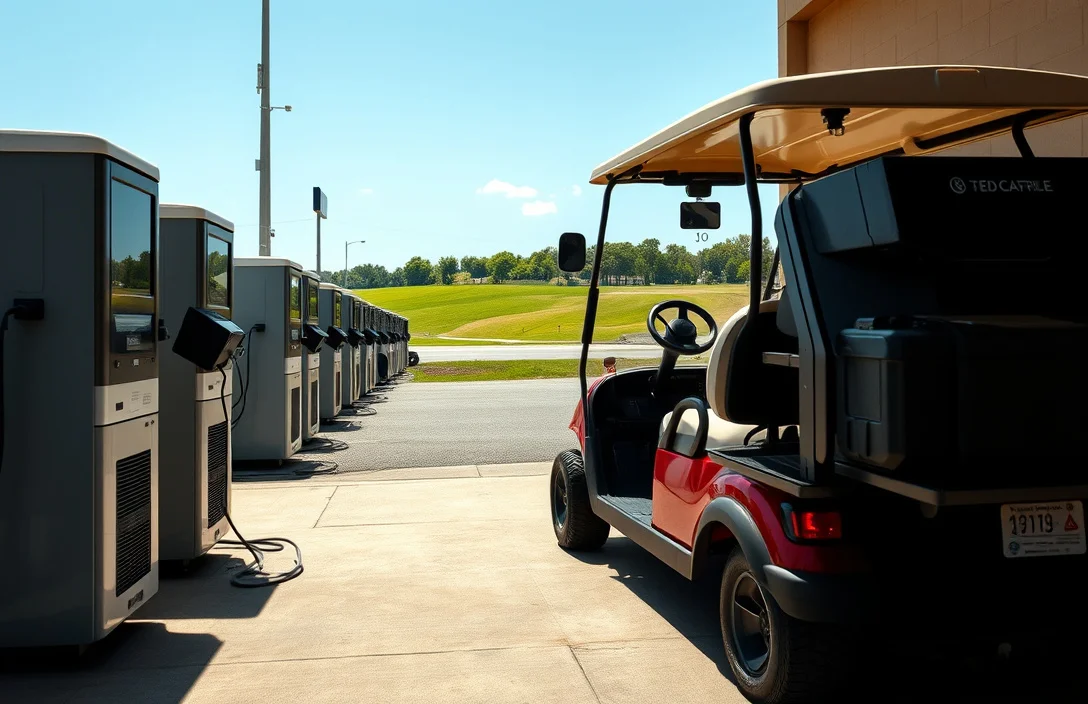
Golf cart battery chargers must match the battery pack voltage (for example 36V, 48V, or 72V) and the charging method (flooded lead acid, AGM, or lithium with a BMS). Using the wrong charger voltage, or the right voltage with the wrong charge profile, is a fast route to premature failure and overheating.
Battery install details matter as much as price when you are sourcing chargers for fleets. Poor cable connections raise resistance, reduce charge acceptance, and increase heat at the terminals. Inspect the charger output label, check connector types, and plan for strain relief so the wiring does not flex every time the cart moves.
Charger types and ports you will encounter
Wholesale lots often include chargers with different plug standards, so you need to verify the interface before you buy. Many carts are straightforward (charger output to the cart system), but some packs integrate a charging port with a specific connector keying scheme.
| Cart/pack voltage | What to verify on the charger | Install compatibility check |
|---|---|---|
| 36V | Charger output rated for 36V pack | Connector matches cart charging port and polarity markings |
| 48V | Charger output rated for 48V pack, correct chemistry profile | Terminals cleaned, tight, and insulated with appropriate covers |
| 72V | Charger output rated for 72V pack | Verify wiring harness voltage rating and segregation from low-voltage leads |
Installation tips and safety checks that prevent failures
Install the charger using the cart manufacturer’s wiring diagram or the battery kit instructions, especially for packs that use a dedicated charging harness. Stop and replace damaged parts if you see cracked insulation, loose spade terminals, heat discoloration near lugs, or swollen battery cases.
Common “cheap fix” problems: loose connections, missing terminal covers, and adapters that fit mechanically but do not lock securely.
Warranty, certifications, and support
Wholesale golf cart batteries should come with clear, written warranty terms that spell out coverage start date, prorating (if any), and what proof is required for a claim. Battery chemistry changes the usual warranty behavior, flooded lead-acid often has shorter coverage and clearer maintenance requirements, while lithium packs usually have electronics and BMS warranty terms that can be narrower but longer.
Warranty terms by chemistry
Golf cart buyers get surprised most often by prorating and by which parts qualify. Flooded lead-acid warranties commonly cover the battery capacity for a set period, then reduce the reimbursement as the years pass. AGM and gel warranties often include stricter install, temperature, and charger behavior requirements, and they may exclude damage tied to abnormal charging.
For lithium packs, warranty language often focuses on the battery management system (BMS) and pack-level faults, while physical abuse, wrong charger settings, water exposure, and incompatible charging profiles can reduce coverage. Pack warranties may also require proof that the charger and operating voltage stay within the manufacturer’s stated limits, so procurement should include the battery datasheet and charger model details.
Certifications to verify
Certifications are a procurement shortcut for safety and basic compliance, especially when you are comparing wholesale offers. Look for evidence tied to lithium transport and charging safety where applicable, and for electrical and safety testing documentation for both the battery and the charger.
Use a supplier checklist during onboarding and audits. In practice, buyers should request the exact document names and issue years, then store them with your purchase records so warranty claims have a paper trail.
| Item to verify | What to request from the supplier | Why it matters for claims |
|---|---|---|
| Battery safety testing | Test reports or compliance statements | Supports “tested for safe operation” in disputes |
| Charger or pack charge compatibility | Charging spec sheet, voltage limits, recommended charge profile | Helps show correct installation and charging behavior |
| Lithium pack transport compliance (if offered) | Transport classification or compliance documentation | Reduces risk from improper handling and paperwork gaps |
Returns and service levels
Returns and service levels are where wholesale suppliers either make procurement easy or create delays. Ask how DOA (dead-on-arrival) is handled, whether batteries can be returned unopened or only after failure analysis, and who pays shipping both ways. For lithium, ask about refurbishing or replacement process steps, since some suppliers repair only the pack while others replace it outright.
In practice, the safest workflow is to build a service plan into your purchase order. The PO should name the warranty start point, serial number handling, and expected service response time, plus a clear path for replacement authorization.
Quick Summary
Wholesale golf cart battery pricing depends mostly on correct pack voltage, chemistry, and quantity, so verify specs before buying.
Frequently Asked Questions
Question 1?
How do I make sure a wholesale golf cart battery price is for the right voltage and capacity, like 36V vs 48V? Before you compare prices, verify the battery label (voltage and amp-hour) and confirm it matches your cart’s battery pack wiring and controller requirements.
Question 2?
Will a cheaper wholesale golf cart battery cause extra heat if I use the wrong charger with it? You should not use a charger that does not match your battery type and voltage, and as a rule, keep charging temperatures within the manufacturer’s stated limits, because excessive heat is a sign of an incorrect charge profile.
Question 3?
What runtime should I expect after buying from wholesale when golf cart battery prices look unusually low? Runtime depends mainly on your battery’s amp-hour rating and your load, so compare amp-hour (Ah) and discharge limits rather than only the sticker price, since two packs with the same voltage can deliver very different usable time.
Question 4?
Is it safe to charge wholesale golf cart batteries indoors, and what safety checks should I do first? Charge in a ventilated area, keep connections clean and tight, and watch for abnormal signs like swelling, strong odor, or excessive casing warmth, because those are stop-charging indicators.
Question 5?
What is a common buying mistake when shopping wholesale golf cart battery prices that leads to early replacement? The biggest mistake is replacing only one battery in a multi-cell string, so try to buy as a matched set for the same chemistry, rating, and age, because mixing old and new packs can shorten cycle life and create uneven charging.