
Interstate Golf Cart Battery Prices: What You’ll Pay And Why
Interstate golf cart battery prices swing hard because “golf cart battery” can mean different voltages and chemistries. The spec that matters most is the battery voltage for your cart (typically 36 V or 48 V), because a wrong match can cook chargers and waste money. The common mistake is buying based on amp-hours alone and skipping the required charger voltage and charge settings. Start by checking the battery label for the exact voltage and charger type before you price shop.
Interstate golf cart battery prices depend on battery voltage (most carts are 36 V or 48 V), capacity (amp-hours), and whether you are replacing lead-acid or a different chemistry. Because compatible chargers and wiring matter, prices can change by hundreds of dollars when voltage or terminal style is wrong. Verify the label voltage first.
interstate golf cart battery prices

Interstate golf cart battery pricing is usually structured around battery type and specs, with the installed cost changing based on whether you buy only the battery or also get dealer service. The biggest price swings come from chemistry (flooded lead-acid, AGM, or lithium), the pack voltage and total capacity, and whether a new, refurbished, or exchange deal is offered. Knowing the spec behind the quote prevents “cheap” batteries from becoming an early re-buy.
What drives the number you see on a quote
Golf cart battery pricing is rarely a single line item. Interstate-style quotes typically separate the battery itself from delivery, pickup, core handling (if exchange applies), and any installation or haul-away labor at the store or dealer level. Compare offers only after you confirm what is included, because two quotes that look different can be apples-to-oranges.
New vs refurbished vs exchange deals can dramatically alter the out-the-door price. Refurbished units can be cheaper, but the effective capacity and the remaining life are the variable that decides whether you saved money. Exchange programs can lower your price by crediting your old battery, but only if your trade-in is acceptable and you meet the program’s condition rules.
| Price driver | What it changes | What to check on the quote |
|---|---|---|
| Chemistry | Upfront cost and charging needs | Flooded vs AGM vs lithium, and charging method notes |
| Voltage | How many cells/modules are required | 36V or 48V pack and configuration |
| Capacity | How long you can drive before voltage drops | Ah or brand-equivalent capacity rating |
| New vs refurbished vs exchange | Upfront price and remaining life uncertainty | Condition requirements and core credit terms |
| Retail vs dealer installation | Labor and service charges | Whether installation, terminal prep, and disposal are included |
Retail listings often show lower prices because they assume you install the battery yourself. Dealer installation pricing is higher because it typically includes labor, terminal inspection, and cart readiness checks, which can be worth it if you need it done correctly the first time.
Interstate golf cart battery prices usually become comparable only after you line up chemistry, voltage, and the capacity spec, then confirm whether installation and exchange terms are included. Lock those details down before you decide based on the lowest sticker price.
Price ranges by battery type
Golf cart battery pricing usually tracks chemistry first (lead-acid vs lithium), then cell format (flooded vs AGM for lead-acid), then system voltage (36 V vs 48 V). For Interstate-style replacement shopping, expect lead-acid options to start lower up front, while lithium typically costs more for the same usable energy. Exact numbers swing by capacity, how many batteries your cart uses per pack, and local retail promotions, so compare like-for-like specs, not just brand.
Lead-acid (flooded and AGM) cost positioning
Lead-acid carts commonly use flooded lead-acid (FLA) or sealed AGM. Flooded units generally cost less, but you trade that savings for routine water checks and careful charger settings to avoid overcharging. AGM costs more because it is sealed, can tolerate vibration better, and usually demands stricter charger compatibility to prevent chronic undercharge or heat.
When you compare prices, use the cart’s required voltage and the battery’s usable capacity (often listed as reserve minutes, amp-hours, or CCA-style figures depending on the listing). For a 36 V or 48 V cart, the “same price” can hide different series counts, which changes the total system cost.
| Battery type | Typical up-front cost position | What drives price most | Trade-off to keep in mind |
|---|---|---|---|
| Flooded lead-acid (FLA) | Lowest | Ah capacity, brand lineup, number of jars per battery, and retail availability | Maintenance and ventilation needs |
| AGM (sealed lead-acid) | Middle | Sealed construction, cold performance listing, and capacity | Higher purchase price, charger setting sensitivity |
| Lithium (pack) | Highest | Battery management system (BMS) design, rated capacity, and discharge capability | Pay more now, verify charger compatibility carefully |
Lithium pricing and why it differs
Lithium packs cost more because they bundle higher energy density, internal protection (BMS), and electronics designed to manage charge and discharge safely. Even when two lithium listings look close in voltage, their charging requirements can differ, and that can affect what charger you need and whether you must replace accessories.
In practice, lithium price is easier to compare when you look for a pack voltage and a capacity rating in usable energy terms (often shown as Ah at the pack voltage). If the listing only says “X volts” without capacity detail, it is harder to judge whether it is a like-for-like upgrade.
Confirm your cart’s required voltage before you price-shop
Cart voltage drives how many batteries you need in series, so it can swing the total bill even when each single battery looks similar in price. For most golf carts, common configurations are 36 V or 48 V, and the system label on the cart, the battery charger nameplate, or the wiring diagram under the seat area typically shows the target voltage.
Safety note: Swollen casings, hot battery tops, damaged terminals, or a strong sulfur smell are red flags for immediate stop and inspection. Mixing chargers, voltages, or different chemistries in the same cart can raise heat and failure risk, so treat voltage confirmation as a safety step, not just a shopping step.
Capacity, runtime, and total cost

Higher-capacity golf cart batteries usually cost more up front because you are paying for more active material, bigger cases, and often higher-output charging capability. Higher capacity can reduce your “cost per hour” since the cart runs longer between charges, but it only helps if you size the battery to the way you drive and if you keep the charger and maintenance on spec.
Capacity specs to verify before comparing prices
Battery listings use different units, so compare at the right level. For flooded lead-acid and AGM, confirm the system voltage (often 36V, 48V, or similar) and the rated capacity in amp-hours (Ah) at a stated discharge rate. For lithium systems, price comparisons are more consistent when you look for energy in watt-hours (Wh) or kilowatt-hours (kWh) and the manufacturer’s defined test conditions.
Capacity is also shaped by discharge rate. A battery that looks “bigger” on a casual Ah number can deliver less usable energy if it is rated at a mild load and your cart pulls harder (hill climbs, towing carts, or aggressive acceleration). Check the label for the C-rate context or, at minimum, the discharge test details.
| What you see on the listing | What to check on the label | Why it changes runtime | Cost impact |
|---|---|---|---|
| Ah (amp-hours) | Stated voltage and discharge rate (example: a specific hours rating) | Higher load can reduce usable capacity | More Ah often raises price, but can lower cost per drive hour |
| Wh or kWh (watt-hours) | System voltage, energy rating method, usable energy range | Energy maps more directly to “time on load” | Bigger kWh usually costs more, but can spread cost over more run time |
| Volts (system voltage) | Confirm it matches the cart controller and wiring (do not mix systems) | Voltage mismatch can cause poor performance or damage | Correct voltage avoids expensive rework or premature replacement |
Runtime limits that quietly drive your real-world cost per hour
Runtime is limited by load, terrain, and battery age, and those factors can swing your results more than the advertised capacity. High-speed driving, steep grades, and frequent starts increase power draw, so you will deplete energy faster. Battery age adds another penalty: internal resistance rises as batteries wear, so they sag more under load and deliver less usable capacity even when the pack reads “charged.”
For lead-acid, temperature matters and so does charge history. If the battery often sits partially charged, sulfation reduces deliverable capacity. For lithium, the pack may throttle if it is cold or hot, so the cart may run shorter until the battery reaches a more usable temperature range.
Total cost checklist: chargers, cadence, and warranty math
Total cost is the sum of the initial battery price plus the “support costs” that determine how long you get before replacement. The charger is the most common hidden line item, especially if the new battery chemistry needs different charge profiles. Confirm your cart’s existing charger is compatible with the battery type and voltage, and that it is sized for the battery’s recommended charging current.
Replacement cadence often depends on how the battery is charged and used, so plan for maintenance supplies and downtime. Compare warranties as part of the price, but focus on what they actually cover (pro-rated terms, time versus cycles, and qualifying conditions). Keep receipts and record charge practices so you can claim coverage if capacity drops faster than expected.
For cost-per-hour comparisons, use the pack’s rated energy (Wh or Ah converted using voltage) as a starting point, then adjust for how your cart loads the battery. If your terrain is hilly and your average discharge is aggressive, “bigger capacity” usually pays back faster, even if it costs more initially.
Charger compatibility checklist
Interstate golf cart packs and chargers must match first on pack voltage, then on chemistry (flooded lead-acid, AGM, or lithium), and finally on the charger’s charge profile limits. A charger that is the right voltage but the wrong chemistry setting can permanently shorten battery life or trigger safety protection.
Voltage and pack grouping checks
Golf cart systems commonly use 36 V or 48 V packs, and chargers are built for a specific output voltage and charging sequence. Verify the pack’s label voltage and the number of series-connected cells or batteries (often written as a 6-volt or 8-volt block arrangement) before buying a charger.
For example, a cart pack may be labeled 48 V even if it is made from different block voltages than you expect. A quick visual count of blocks plus the voltage printed on the pack label is usually faster than searching model-specific charts.
Chemistry settings and charging profile match
Lead-acid chargers use a bulk, absorption, and float approach, and the setpoints differ between flooded and AGM. Lithium packs rely on a profile that is coordinated with the battery’s BMS, and some lithium packs require charger outputs within a tight voltage and current window.
Charger modes often change more than voltage. Temperature compensation (for lead-acid) and current taper behavior (for lithium) can be the difference between long life and chronic overheat.
| What you check | Why it matters | Where to find it |
|---|---|---|
| Pack voltage (36 V / 48 V) | Wrong voltage can undercharge or overcharge | Battery label, charger output spec |
| Chemistry mode (flooded, AGM, lithium) | Wrong profile shortens life or trips protection | Charger front panel, battery manual |
| Charge current limit (amps) | Overcurrent can heat cells or stress BMS | Charger rating, battery maximum charge current |
| Connector and lead polarity | Bad fit or reversal prevents safe charging | Charger plug/lead markings, pack terminal notes |
Safety warning: A swollen battery, a charger that smells hot, or a damaged charge cable means stop. Power down, disconnect the charger, and inspect connections before trying anything else.
Charging safety and heat control
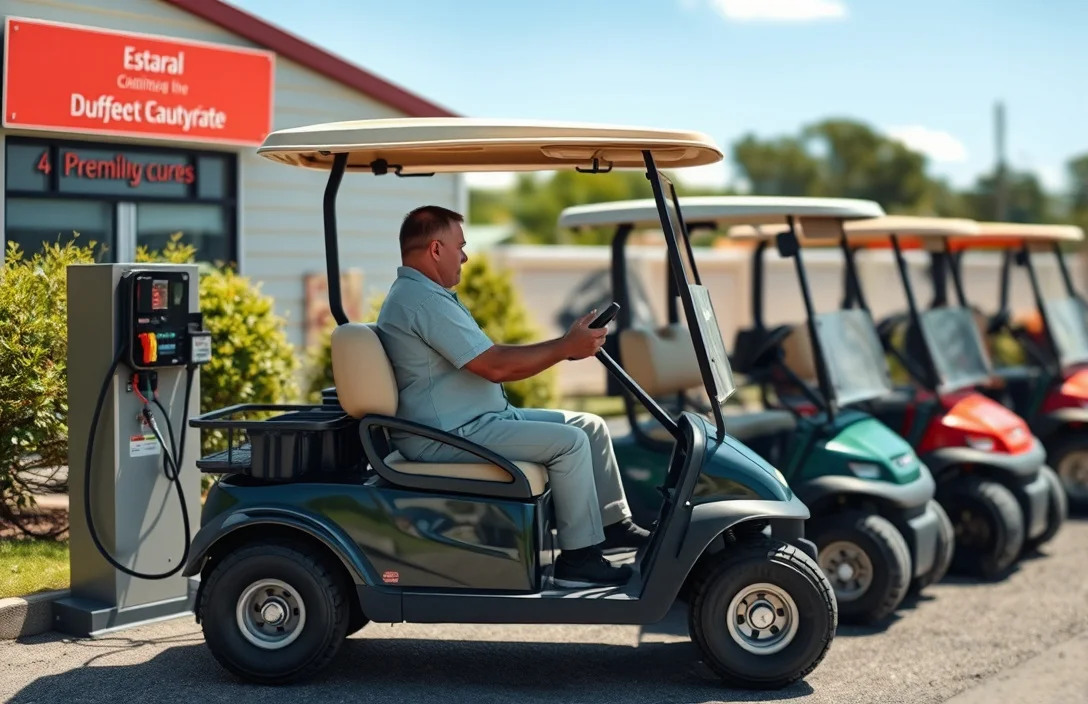
Heat is the fastest way to turn a discounted golf-cart battery into a short-lived one, because high temperature accelerates plate corrosion and can push electrolyte to vent. Stop charging when the battery casing is hot to the touch, the vent caps spit, or the battery stops behaving normally.
Interstate golf-cart battery pricing often looks attractive, but safety behavior during charging matters more than the sticker price when you see heat rise. Charging should be steady and controlled, with voltage that follows the charger’s expected profile for the battery type.
What overheating looks like, and when to stop
Overheating often starts subtly, then escalates quickly. A battery may feel warm during normal charge, but aggressive heat, strong odor, or rapid bubbling means something is wrong.
Stop charging immediately if you see any of the following, then let the battery cool in a safe, ventilated area. Re-start only after you fix the cause (wrong charger settings, damaged wiring, or bad cells).
Swelling, leaking, and venting warning signs
Swelling is a serious red flag because it means internal pressure is rising. Leaking fluid, crust around terminals, or wetness around seams can indicate electrolyte loss, which reduces performance and increases corrosion risk.
Safety rule: If a battery is venting, leaking, or visibly deformed, treat it as unsafe to charge. Wear eye protection and keep ignition sources away until the battery is handled according to the manufacturer’s disposal or service guidance.
| Observed symptom | What it often means | Action |
|---|---|---|
| Battery casing is hot, strong odor, heavy bubbling | Excessive gassing, charger mismatch, or failing cell | Disconnect charger and inspect wiring and charger settings/type |
| Case bulges or top warps | Internal pressure or chemistry failure | Do not continue charging, arrange replacement/service |
| Wetness, crust, or liquid near terminals | Electrolyte leak and elevated corrosion | Stop charging, clean only after power is disconnected and per safety guidance |
| Charger repeatedly restarts | Fault detection or unstable connection | Check terminals, cable integrity, and charger compatibility, then retest |
Ventilation and charging location rules of thumb
Gassing can happen if a flooded lead-acid battery is overcharged or near the end of charging, so ventilation is not optional. A sheltered garage corner can become a gas pocket, especially when the battery sits in a battery box with limited airflow.
Cold weather can cause chargers to work harder, which can increase heat once the battery starts accepting current. If the battery feels very cold at the start, charge location temperature and charger settings become more important, and you should stop charging if heat ramps unusually fast.
Replacement triggers and testing
Prices for Interstate golf cart batteries vary widely by chemistry and capacity, and local dealers set the final price. If you notice slow cranking, weak acceleration, or early cutoff, replacing the pack is often cheaper than chasing performance across multiple fixes. Since pricing is dealer dependent, get current quotes and compare with a professional load test before buying.
| Trigger / Symptom | What it implies | Test or check | Price note |
|---|---|---|---|
| Slow cranking or weak acceleration | Pack may have reduced capacity or aging cells | Measure voltage under a controlled load; compare to healthy baseline; inspect connections for corrosion | Prices vary by chemistry; expect higher cost for lithium packs; verify local Interstate distributor price |
| Early cutoff during use | High internal resistance or sulfation limits runtime | Run a load test; check resting voltage after rest; test battery balance if equipment allows | Prices depend on vendor and kit; consider warranty options |
| Visible swelling or heat during charging | Unsafe condition; cells may be failing | Stop use, inspect terminals, cables, and venting seals; have the pack tested by a pro if swelling is confirmed | Swollen packs should be replaced; price varies by chemistry |
| Significant voltage sag under normal load | Remaining capacity far below rating | Apply a known load and observe instantaneous sag; compare to manufacturer specs or a known good pack | Higher cost packs may justify replacement; price varies by dealer |
Voltage drop under load is a practical diagnostic. A healthy golf cart pack maintains voltage with a reasonable drop when the load is applied, while a tired pack sags quickly. Use a load tester or a controlled draw from the cart and measure the pack voltage at peak draw, then compare to your rested voltage. If the sag is large or the rest voltage is low, replacement is often the sensible choice rather than incremental fixes.
When service testing beats guess and buy. If you are balancing multiple batteries, or if the cart must perform in demanding conditions, a battery service test can quantify remaining life and identify sulfation, bad cells, or imbalance. This approach can prevent paying for a premature replacement or chasing a non-existent fault and helps you choose the right Interstate option for your setup.
Buy-ready fit and warranty checks
Interstate golf cart batteries must fit your cart’s mounting and electrical interface exactly. Verify the model’s overall dimensions, terminal style, and mounting footprint to avoid misfit and safety issues.
Keep all purchase records and the original packaging in case you need service or exchanges under warranty. Store digital copies and note the purchase date, model number, and seller details so you can prove eligibility if a claim arises.
| Check item | What to verify | Why it matters |
|---|---|---|
| Model/Part number | Matches your cart’s battery configuration | Prevents in-warranty disputes and misfit. |
| Dimensions (L×W×H) | Fits tray or compartment without modification | Avoid obstructions and mounting issues. |
| Terminal style and polarity | Post type and position align with cables | Ensures safe connections and correct polarity. |
| Mounting pattern and weight | Same bolt spacing or compatible rack | Stability and load considerations |
| Chemistry and rated capacity | Lead-acid, AGM or lithium, Ah rating | Impact on cart performance and charging compatibility. |
| Warranty terms | Duration, pro-rated coverage, installation requirements | Defines what is covered and for how long. |
| Documentation required | Receipt, date code, serial, warranty card | Needed to file a claim or return. |
In practice, price alone rarely tells the full story. For example, an Interstate battery listed at a tempting price might not be the right size or chemistry for your cart, voiding the warranty if installed improperly.
Quick Summary
Prices for interstate golf cart batteries vary by model and region, so compare quotes locally before buying.
Frequently Asked Questions
What voltage configurations do Interstate golf cart batteries use, and how does that affect price and compatibility?
Interstate golf cart batteries commonly come in 6V and 8V configurations; matching your cart’s voltage is essential to avoid buying the wrong model or paying for adapters.
Will Interstate golf cart batteries get hot during charging, and how should I manage heat?
In normal use, you should not see strong heat buildup; keep the charging area well ventilated and away from heat sources. If the battery case feels warm to the touch, pause charging and recheck ventilation.
How does the amp-hour rating affect runtime and price when choosing Interstate golf cart batteries?
A higher AH rating generally yields longer run time per charge; price scales with capacity, so compare AH alongside voltage for a fair comparison.
How do I know when an Interstate golf cart battery needs replacement, and what does that mean for safety and cost?
Look for swelling, leakage, or corrosion; replacing a deteriorating battery reduces safety risk and can prevent costly damage to the cart’s electrical system.
What are common buying mistakes when shopping Interstate golf cart batteries that can waste money?
Don’t buy by price alone; ensure you pick the correct voltage (6V or 8V) and that the charger is compatible, and consider warranty and reputable outlets to avoid counterfeit products.